
How to Read a Pay Stub: Gross Pay, Net Pay, Taxes, and Deductions

how to read a pay stub
Your pay stub tells the story behind your paycheck. It shows how much you earned, what was taken out, and how much money you actually receive. But if you’ve ever looked at a pay statement and wondered why your gross pay is higher than your direct deposit, you’re not alone.
A pay stub can include several unfamiliar terms: gross earnings, federal withholding, FICA, pre-tax deductions, net pay, and year-to-date totals. Understanding these figures can help you check your earnings, review benefit costs, and catch possible payroll mistakes.
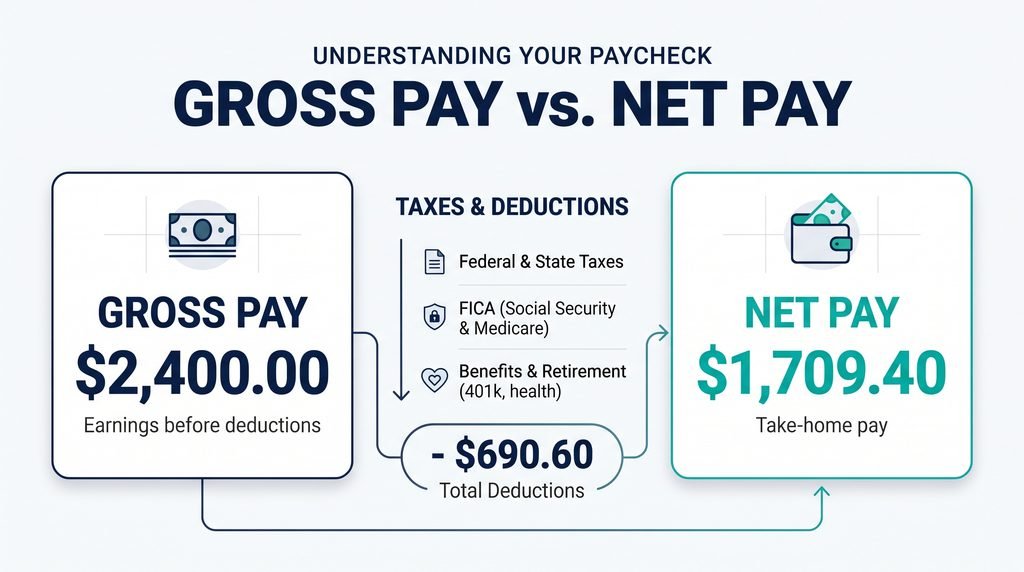
The easiest way to read a pay stub is to follow the money in order: start with gross pay, review taxes and other deductions, then check net pay. Finally, compare the year-to-date figures with your previous pay statements.
This guide explains each section in plain English, walks through an illustrative example, and gives you a checklist for reviewing your next paycheck.
What Is a Pay Stub?
A pay stub is a document that explains how your employer calculated your pay for a particular pay period. It generally shows your earnings, taxes withheld, other deductions, and final take-home pay.
You may receive a pay stub:
- With a paper paycheck.
- Through your employer’s payroll portal.
- As a downloadable PDF.
- Through a payroll or employee benefits app.
A pay stub is not the same as a paycheck. The paycheck or direct deposit is the money you receive. The pay stub explains how your employer arrived at that amount.
The exact format varies by employer, payroll provider, and state requirements. Some statements use different labels or combine information into fewer sections, but the main figures are usually similar.
The Main Parts of a Pay Stub
Most pay statements contain some combination of these sections:
| Pay-stub section | What it tells you |
|---|---|
| Pay period | The dates covered by this payment |
| Pay date | When the money is issued |
| Gross pay | Earnings before deductions |
| Earnings details | Salary, hours, overtime, bonuses, and other pay |
| Taxes withheld | Taxes deducted from your earnings |
| Other deductions | Benefits, retirement contributions, and other deductions |
| Net pay | The amount left after deductions |
| Year-to-date (YTD) | Cumulative totals for the year |
Start by checking the employee and pay-period information. Make sure the statement belongs to you and covers the correct dates. Then review the earnings and deductions before checking the final amount.
1. Understand Your Gross Pay
Gross pay is the total amount you earn before taxes and other deductions are taken out.
It is not necessarily the amount deposited into your bank account.
For an hourly employee, gross pay may include:
- Regular hours worked.
- Overtime hours.
- Shift differentials.
- Bonuses or commissions.
- Paid time off, depending on the employer’s payroll treatment.
For a salaried employee, gross pay generally reflects the portion of the agreed salary paid during that pay period, along with any additional eligible earnings.
Example: Calculating gross pay
Imagine you earn $20 per hour and work 80 regular hours during a two-week pay period.
Your regular earnings would be:
$20 × 80 hours = $1,600
If you also receive $100 in eligible additional earnings, your gross pay for the period would be $1,700.
This is the amount before payroll taxes and other deductions.
Regular pay, overtime, and bonuses
Your pay stub may list earnings in separate rows. For example, regular pay and overtime pay may appear separately so you can see how each contributed to your total.
Do not assume that every additional payment is calculated or taxed in exactly the same way. Review the earnings descriptions and ask payroll if a line is unclear.
2. Review the Taxes Withheld
Taxes withheld are amounts your employer deducts from your pay and generally sends to the appropriate tax authorities.
Depending on where you work and your circumstances, your pay stub may show federal income tax, state income tax, local income tax, Social Security tax, and Medicare tax.
Federal income tax
Federal income tax withholding is money your employer withholds toward your federal income-tax obligation.
The amount can depend on factors such as:
- Your wages.
- The information on your Form W-4.
- Your pay frequency.
- Your withholding elections and other applicable circumstances.
Federal income-tax withholding is not necessarily your final tax bill. Your actual federal tax liability is determined when you file your tax return. You may receive a refund or owe additional tax depending on your overall tax situation and payments made during the year.
how to read a pay stub
State and local income taxes
Some states and local jurisdictions impose income taxes. If applicable, these may appear as separate deductions on your pay stub.
The amount and rules vary by location. Some employees may not see a state or local income-tax deduction at all.
If you work in one state and live in another, or have moved during the year, your withholding situation may require additional attention.
Social Security tax
Social Security tax helps fund federal Social Security programs.
For 2026, the employee Social Security tax rate is generally 6.2% of covered wages, up to the annual Social Security wage base of $184,500.
For example, if $2,400 of your pay is subject to Social Security tax, the employee portion would be:
$2,400 × 6.2% = $148.80
The annual wage limit matters. Once your covered wages reach the applicable annual wage base, Social Security withholding generally stops for the rest of that calendar year with that employer. If you have multiple employers, the treatment across employers may be different when you file your tax return.
Medicare tax
Medicare tax helps fund Medicare.
The standard employee Medicare tax rate is generally 1.45% of covered wages. Unlike Social Security tax, regular Medicare tax does not have the same annual wage cap.
Using the same $2,400 example:
$2,400 × 1.45% = $34.80
Some higher-income employees may also have Additional Medicare Tax withholding. This is separate from the standard Medicare rate and applies under specific rules.
What does FICA mean?
FICA stands for the Federal Insurance Contributions Act. It is the federal law associated with Social Security and Medicare payroll taxes.
Your pay stub may show these taxes as separate lines:
- Social Security.
- Medicare.
Or it may use a combined FICA label. If you see a FICA deduction, check whether the statement also provides a breakdown.
3. Understand Other Pay Stub Deductions
Not every deduction is a tax. Employers may also deduct money for benefits, retirement plans, or other authorized purposes.
Common examples include:
| Deduction | What it may cover |
|---|---|
| Health insurance | Your share of medical insurance premiums |
| Dental insurance | Dental coverage |
| Vision insurance | Vision coverage |
| 401(k) contribution | Retirement savings |
| HSA contribution | Health Savings Account contributions |
| FSA contribution | Flexible Spending Account contributions |
| Life insurance | Employer-provided or supplemental coverage |
| Other authorized deductions | Items such as certain benefit costs or employee-authorized payments |
Your employer may offer some of these benefits, but not every employee will have the same deductions.
Check the deduction names and amounts against your benefits elections and payroll records.
Pre-tax vs. post-tax deductions
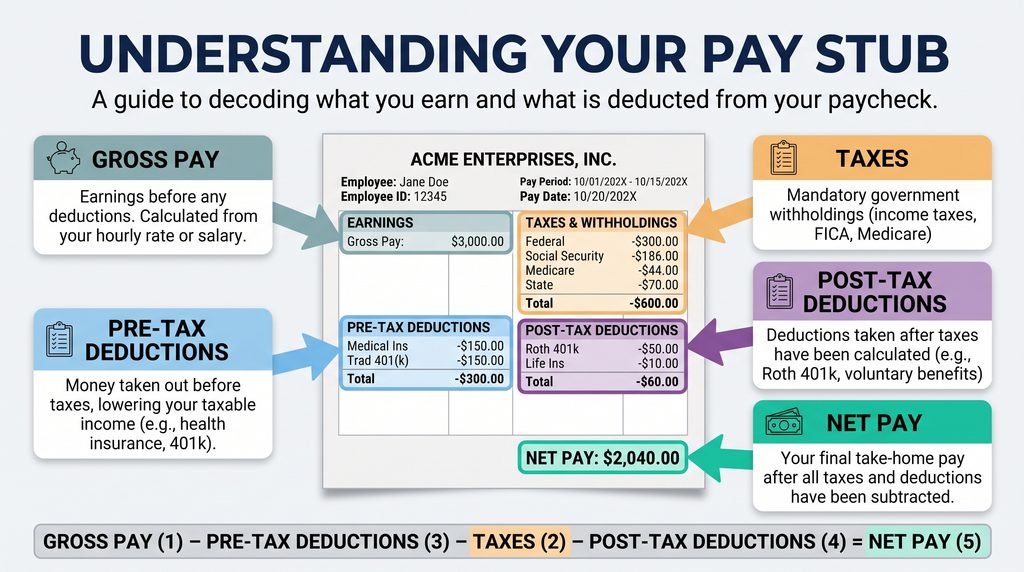
One important distinction is whether a deduction is taken before or after certain taxes are calculated.
Pre-tax deductions are generally taken out before calculating certain taxable wages, depending on the type of benefit and applicable tax rules.
Examples may include qualifying health insurance premiums, traditional 401(k) contributions for federal income-tax purposes, and certain eligible benefit-plan contributions.
Post-tax deductions are taken out after the applicable taxes have been calculated.
Examples can include certain insurance premiums, Roth 401(k) contributions, and other deductions that do not qualify for pre-tax treatment.
The distinction matters because it can affect the wages used to calculate different taxes. A deduction that reduces federal income-tax wages does not necessarily reduce Social Security or Medicare wages.
For example, traditional 401(k) contributions generally reduce wages subject to federal income tax but usually do not reduce Social Security and Medicare wages. Roth 401(k) contributions are generally made after income taxes.
If you are unsure how a particular deduction is treated, check your plan documents or ask your payroll or benefits department.
4. Find Your Net Pay
Net pay is the amount remaining after applicable taxes and deductions are subtracted from gross pay.
It is often called:
- Take-home pay.
- Net earnings.
- Net check.
- Net amount.
This is generally the figure that matters most when checking how much money you will receive.
The basic calculation is:
Gross pay − taxes withheld − other deductions = net pay
Example: A simple illustrative pay stub
Imagine an employee has the following pay statement for one pay period:
| Description | Amount |
|---|---|
| Gross pay | $2,400.00 |
| Federal income tax | −$210.00 |
| State income tax | −$72.00 |
| Social Security tax | −$148.80 |
| Medicare tax | −$34.80 |
| Health insurance | −$90.00 |
| Traditional 401(k) contribution | −$120.00 |
| Other authorized deduction | −$15.00 |
| Total deductions | −$690.60 |
| Net pay | $1,709.40 |
The calculation is:
$2,400.00 − $690.60 = $1,709.40
In this fictional example, the employee’s gross pay is $2,400, but the take-home amount is $1,709.40.
Important: This is an educational example, not a tax-withholding estimate. The federal and state withholding amounts and other deductions are illustrative. Actual amounts depend on the employee’s circumstances, location, benefits, payroll elections, and applicable rules.
5. What Does Year-to-Date (YTD) Mean?
YTD stands for year-to-date. It shows the cumulative amount recorded from the beginning of the calendar year through the current pay period.
Your pay stub may show YTD totals for:
- Gross earnings.
- Federal income tax withheld.
- State and local taxes withheld.
- Social Security tax.
- Medicare tax.
- Retirement contributions.
- Insurance deductions.
- Net pay.
For example, if your current pay period shows $2,400 in gross pay and your YTD gross pay is $19,200, the YTD figure represents the accumulated gross earnings recorded so far for the year.
YTD figures are useful because they help you:
- Track your earnings over time.
- Review how much tax has been withheld.
- Monitor retirement contributions.
- Compare payroll records with year-end tax documents.
- Check whether your Social Security wages are approaching the annual wage base.
Remember that YTD totals can change after payroll corrections or adjustments. If a number seems inconsistent, compare it with earlier statements and ask payroll for an explanation.
6. Why Is Your Paycheck Different From Last Time?
A change in take-home pay does not automatically mean something is wrong. Your gross pay, withholding, or deductions may have changed.
Here are some common reasons.
You worked different hours
Hourly employees may receive different pay when they work more or fewer hours, take unpaid leave, or receive overtime.
You received a bonus or commission
Additional earnings can increase gross pay and affect withholding for that pay period.
Your tax withholding changed
A new Form W-4, a change in payroll information, or a withholding adjustment may change the amount of federal income tax deducted.
Your benefits changed
Health insurance premiums, retirement contributions, or other benefit deductions may change after an enrollment update or qualifying life event.
You reached a payroll-tax wage limit
For employees whose covered wages reach the Social Security wage base during the year, Social Security withholding generally stops once the applicable limit is reached with that employer. This can increase take-home pay later in the year even when gross pay remains similar.
You received a pay adjustment
Retroactive pay, corrections, reimbursements, or other payroll adjustments can affect the amount shown on a statement.
When your paycheck changes, compare the current pay stub with the previous one. Look for the line that changed rather than focusing only on the final deposit.
7. How to Check Your Pay Stub for Errors
Reviewing your pay statement regularly can help you spot mistakes before they become bigger problems.
Use this checklist each payday:
- Confirm your name and employee information.
- Check the pay-period dates and pay date.
- Confirm your regular hours or salary.
- Review overtime, bonuses, commissions, and other earnings.
- Compare gross pay with your expected earnings.
- Check federal, state, and local tax withholding where applicable.
- Review Social Security and Medicare deductions.
- Compare benefit deductions with your current elections.
- Check retirement contributions.
- Confirm that other deductions are familiar and authorized.
- Recalculate the total deductions.
- Confirm that net pay matches the amount issued or deposited.
- Review YTD totals for unexpected changes.

Common pay stub issues to watch for
Some possible issues include:
Incorrect hours: Your statement may show fewer or more hours than you actually worked.
Missing overtime: Eligible overtime hours may be missing or incorrectly recorded.
Unexpected deductions: A benefit or other deduction may appear that you do not recognize.
Incorrect pay rate: Your hourly rate or salary may not reflect an agreed change.
Unexpected tax withholding: A change in tax withholding may need an explanation, especially if you did not change your payroll information.
Incorrect year-to-date totals: A payroll correction or data-entry issue may affect cumulative figures.
Not every unexpected difference is an error. Some changes are legitimate adjustments or reflect how payroll systems calculate taxes and benefits.
8. What Should You Do If Your Pay Stub Looks Wrong?
If you notice something that does not look right, keep a copy of the statement and gather the relevant information before contacting your employer.
A practical process is:
- Identify the specific line. Write down whether the issue involves hours, pay rate, overtime, taxes, benefits, or another deduction.
- Compare previous pay stubs. Check whether the amount changed and when the change first appeared.
- Review your records. Gather time sheets, schedules, pay agreements, benefit elections, or other relevant documents.
- Contact payroll or HR. Explain the discrepancy clearly and ask for the calculation or deduction details.
- Keep the response. Save any written explanation or correction notice.
- Follow up if needed. If the issue is not resolved, consult the appropriate state labor agency or the U.S. Department of Labor, depending on the nature of the problem.
For wage-and-hour concerns, the Department of Labor’s Wage and Hour Division provides information about federal labor standards. State laws may provide additional protections.
Do not assume that a pay stub alone answers every legal or tax question. For complex tax concerns, a qualified tax professional may be able to help.
Frequently Asked Questions About Reading a Pay Stub
What is the difference between gross pay and net pay?
Gross pay is your earnings before taxes and other deductions. Net pay is the amount left after applicable deductions are subtracted. Net pay is generally the amount you receive through direct deposit or a paycheck.
Why is my net pay lower than my salary?
Your salary is usually stated before payroll deductions. Your employer may withhold federal, state, and local taxes, along with Social Security and Medicare taxes. Benefit premiums, retirement contributions, and other deductions can also reduce take-home pay.
What does FICA mean on a pay stub?
FICA stands for the Federal Insurance Contributions Act. It refers to Social Security and Medicare payroll taxes. Your pay statement may list these taxes separately or show them together under a FICA label.
What does YTD mean on a pay stub?
YTD means year-to-date. It represents the cumulative amount recorded from the beginning of the year through the current pay period. It may include earnings, taxes withheld, deductions, and other payroll totals.
Are all pay stub deductions taxes?
No. Taxes are only one type of deduction. Your pay stub may also show health insurance, retirement contributions, and other benefit or authorized deductions.
What is the difference between pre-tax and post-tax deductions?
Pre-tax deductions are taken out before calculating certain taxable wages, depending on the deduction and applicable rules. Post-tax deductions are taken out after the applicable taxes have been calculated. Different deductions can affect different tax calculations.
Why does my paycheck change if my hourly rate stays the same?
Your take-home pay can change because of different hours, overtime, bonuses, withholding adjustments, benefit costs, retirement contributions, or payroll corrections. Compare the individual pay-stub lines to identify the reason.
Should I keep my pay stubs?
Keeping pay stubs can help you track earnings, review deductions, resolve payroll questions, and compare your records with year-end tax documents. Follow your employer’s record-access procedures and retain personal copies securely.
The Bottom Line
A pay stub is more than a record of how much money you received. It explains how your earnings became your take-home pay.
Start with gross pay, review the taxes withheld, check benefit and other deductions, and confirm the net-pay amount. Then look at your year-to-date totals and compare the statement with your previous pay period.
A few minutes of review each payday can help you understand your income, monitor deductions, and notice possible payroll problems sooner.
If you are using your take-home pay to plan household expenses, the Paycheck Budget Calculator can help you organize your income around your pay schedule.
Educational disclaimer: This article provides general financial and payroll education for U.S. readers. It is not individualized tax, legal, or employment advice. Payroll treatment varies by employee circumstances, employer plans, state and local rules, and applicable federal law.