
How to Make a Monthly Budget That Actually Works

Budget That Actually Works
A monthly budget gives every dollar of your household income a purpose before bills, everyday purchases, and unexpected costs compete for it. It can help you understand where your money goes, prepare for upcoming expenses, and make room for priorities such as savings or debt payments.
You do not need a complicated spreadsheet or a perfect record of every purchase to begin. You need a realistic picture of your take-home income, a clear list of expenses, and a plan you can adjust as your circumstances change.
This guide walks through how to make a monthly budget step by step, including a worked example using $5,400 in monthly take-home income.

Quick answer: How do you make a monthly budget?
To make a monthly budget:
- Calculate your household’s monthly take-home income.
- Review bank statements, bills, and recent spending.
- List fixed, variable, and occasional expenses.
- Set amounts for savings and financial goals.
- Assign the remaining money to flexible spending.
- Check when income arrives and bills are due.
- Track actual spending and adjust the plan each month.
The basic calculation is:
Budget That Actually Works
Monthly take-home income − planned monthly expenses = money left over
A positive result gives you room to save, spend, or build a financial cushion. A negative result means the plan needs adjusting before the month begins.
What is a monthly budget?
A monthly budget is a plan for how you will use the money your household expects to receive and spend during a month.
It compares income with expenses and helps you decide how much to allocate to essentials, financial obligations, savings, and discretionary purchases.
A budget is not simply a list of bills. It should also account for expenses that change from month to month, costs that occur only a few times a year, and the timing of your paychecks.
The goal is not to predict every purchase perfectly. It is to make informed decisions with the money available.
Step 1: Calculate your monthly take-home income
Start with the money you can actually use, not your gross salary.
Take-home pay is the amount deposited into your account after payroll deductions such as taxes and other withholding. If you receive multiple sources of household income, include the amounts that are reasonably dependable.
Your income list might include:
- Paychecks from employment
- Self-employment income after setting aside money for applicable taxes
- Regular benefits or support payments
- Pension or retirement income
- Other dependable recurring income
For income that changes, avoid building essential expenses around your best month. Use a conservative estimate based on your recent income history.
If you are paid weekly or every two weeks, calculate the monthly average carefully. For example, if you receive 26 biweekly paychecks per year, multiply one typical paycheck by 26 and divide by 12 to estimate average monthly take-home income. Do not assume that every calendar month contains exactly two biweekly paychecks.
If your income is irregular or seasonal, consider using a conservative monthly estimate based on a longer period of records. Keep a separate cash-flow plan so you know whether money will be available when bills are due.
Step 2: Review what you actually spend
Before setting spending limits, find out where your money currently goes.
Review several months of:
- Checking-account transactions
- Credit-card statements
- Utility and insurance bills
- Receipts and cash purchases
- Subscription payments
- Debt statements
- Medical, childcare, and transportation costs
Group transactions into understandable categories. You can start with broad categories and add detail only when it helps you make a decision.
For example, combine grocery-store purchases into groceries, but keep restaurant spending separate if you want to manage those costs independently.
Do not change the numbers just because you think you should be spending less. Record your current spending first. You can decide what to change after you understand the baseline.
The Consumer Financial Protection Bureau recommends reviewing actual account history and including less-frequent expenses when assessing household spending.
Step 3: Organize your monthly budget categories
A useful budget separates expenses according to how they behave and how important they are to your household.
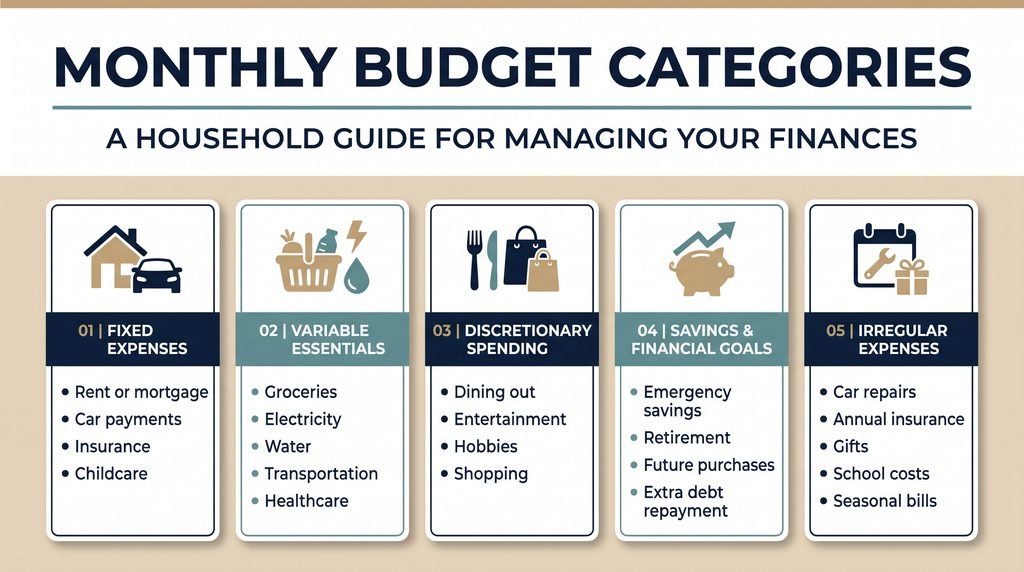
Fixed expenses
Fixed expenses are generally predictable and repeat regularly.
Examples include:
- Rent or mortgage payments
- Car payments
- Insurance premiums
- Childcare payments
- Internet plans
- Minimum debt payments
Some fixed expenses can change when contracts renew or rates increase, so check them periodically.
Variable essential expenses
These costs are necessary but may change from month to month.
Examples include:
- Groceries
- Electricity and gas
- Water
- Fuel and public transportation
- Medical expenses
- Household supplies
Use recent bills and transaction history to estimate these amounts. For utilities or seasonal expenses, compare several months rather than relying on one unusually low bill.
Discretionary expenses
These are purchases that are more flexible and may be easier to reduce or postpone.
Examples include:
- Restaurants and takeout
- Entertainment
- Hobbies
- Nonessential shopping
- Optional subscriptions
- Personal treats
Discretionary does not mean unimportant. Your budget should reflect the activities and experiences that matter to your household while keeping essential obligations covered.
Savings and financial goals
Include planned contributions for goals such as:
- Emergency savings
- Retirement contributions
- A future vehicle or home expense
- Education
- Travel
- Additional debt repayment
Treat savings as a planned use of income rather than relying only on whatever happens to remain at the end of the month.
Step 4: Plan for irregular expenses
One of the easiest ways to make a monthly budget unrealistic is to forget expenses that do not arrive every month.
Examples include:
- Annual insurance premiums
- Vehicle maintenance and repairs
- School supplies and fees
- Holiday and birthday gifts
- Medical and dental costs
- Seasonal utility bills
- Annual memberships
- Travel and family events
If you expect to spend $1,200 on an expense once a year, you can plan for it by setting aside $100 each month.
Monthly contribution = expected expense ÷ number of months until payment
For example:
$1,200 ÷ 12 = $100 per month.
This is sometimes called a sinking fund. It is money reserved for a known future expense, rather than money intended for an unexpected emergency.
If the expense is due sooner than 12 months, divide the amount by the number of months remaining. If the amount is uncertain, use a reasonable estimate and update it when you have better information.
Step 5: Choose a budgeting method
There is no single budgeting method that works for every household. Choose a system that fits your income, expenses, and preferred level of detail.
The 50/30/20 budget rule
This method divides take-home income into three broad groups:
- 50% for needs
- 30% for wants
- 20% for savings and debt repayment
It can be a useful starting framework, but it is not a rule that every household can follow. Housing costs, healthcare, childcare, debt, and local living expenses can make these percentages unrealistic.
Read our guide to the 50/30/20 Budget Rule Explained for a closer look.
Zero-based budgeting
With zero-based budgeting, you assign all available income to planned categories until income minus planned allocations equals zero.
This does not mean spending every dollar. Savings, debt repayment, and future-expense funds can all receive allocations.
This approach offers detailed control, but it requires more regular tracking.
Learn more in Zero-Based Budgeting Explained.
Flexible budgeting
A flexible budget sets firm amounts for important obligations while allowing variable categories to change within reasonable limits.
For example, your rent may stay fixed while your grocery, fuel, and entertainment amounts change based on actual needs.
This can be easier to maintain when household costs vary.
Step 6: Build your monthly spending plan
Now combine your income, expense categories, irregular-expense contributions, and financial goals.
Start with essential obligations. Then add variable necessities, savings, debt goals, irregular-expense funds, and discretionary spending.
Here is an illustrative example of a household with $5,400 in monthly take-home income.
Example: A monthly budget using $5,400
| Budget category | Monthly amount |
|---|---|
| Housing | $1,600 |
| Utilities | $250 |
| Groceries | $600 |
| Transportation | $450 |
| Insurance and healthcare | $400 |
| Debt payments | $400 |
| Phone and internet | $150 |
| Personal and household expenses | $300 |
| Dining and entertainment | $250 |
| Irregular-expense funds | $300 |
| Savings | $400 |
| Remaining flexible amount | $300 |
| Total planned income | $5,400 |
In this example, the household assigns all $5,400 to planned uses.
The $300 flexible amount provides some room for categories that are difficult to predict. It is not guaranteed to cover every unexpected cost, and the household may need to adjust it based on its actual spending.
The figures are illustrative, not recommended spending targets. A household’s appropriate amounts will depend on location, household size, income, debt, insurance, and other circumstances.
How to make a monthly budget
Check your budget calculation
Add all planned allocations and compare the result with take-home income.
For this example:
$5,400 − $5,400 = $0
The plan balances. That does not automatically mean it is affordable or realistic. Compare the amounts with actual bills and spending records before relying on it.
You can use the Monthly Budget Calculator to organize your own figures.
Step 7: Match your budget to your paydays and bill due dates
A monthly budget can balance on paper while still leaving you short during a particular week.
For example, rent may be due at the beginning of the month while a paycheck arrives later. The total monthly income may cover the total monthly expenses, but the timing can still create a cash shortage.
Create a simple bill calendar that records:
- Expected paycheck dates
- Rent or mortgage due date
- Utility and insurance due dates
- Loan and credit-card payments
- Other recurring obligations
Then divide your monthly plan into pay periods if that makes it easier to manage.
If you receive biweekly pay, our guide to How to Budget on a Biweekly Paycheck explains how to plan around that schedule.
The CFPB’s cash-flow budgeting guidance also emphasizes tracking when money comes in and when expenses must be paid.
Step 8: Track your spending during the month
A budget is only useful if you compare the plan with what actually happens.
Choose a tracking method you can maintain:
- A spreadsheet
- A budgeting app
- A notebook
- Your bank’s transaction categories
- A simple list of weekly totals
Check your spending regularly. You do not need to record every purchase in a complicated system, but you should know whether important categories are approaching their limits.
For example, if your grocery allocation is $600, check the amount spent during the month rather than waiting until the final day to discover that it was exceeded.
Use the Monthly Expense Calculator to organize and review your expenses.
Step 9: Adjust the budget when expenses exceed income
If planned expenses are higher than take-home income, do not ignore the difference or assume it will disappear.
Start by checking that your income and expenses are complete. Then review the plan in a practical order:
- Identify essential bills and obligations that must be prioritized.
- Look for discretionary spending that can be reduced or postponed.
- Review recurring services and subscriptions.
- Check whether any bills or payment dates can be adjusted.
- Revisit variable expenses using realistic estimates.
- Review savings and extra debt-payment targets if the current plan is not workable.
Avoid cutting expenses that protect health, safety, housing, or the ability to work without carefully considering the consequences.
If your income is irregular, build the plan around a conservative income estimate and keep flexible spending adjustable. A cash-flow budget can help identify the weeks when money may be short.
If the gap is persistent or involves serious debt distress, consider contacting a qualified nonprofit credit counselor or another appropriate professional.
Step 10: Review and improve your budget every month
Your first budget is a starting point, not a permanent set of rules.
At the end of each month, compare planned amounts with actual spending.
Ask:
- Which categories were close to the plan?
- Which expenses were higher than expected?
- Did any annual or irregular expense arrive?
- Was there enough money available on each bill’s due date?
- Did the savings contribution fit the household’s circumstances?
- What should change next month?
If a category is repeatedly higher than planned, adjust the estimate or investigate the reason. A realistic budget should reflect how your household actually operates.
A short monthly review is often easier to maintain than a complicated system that takes too much time.
Common monthly budgeting mistakes
1. Using gross income instead of take-home pay
Your gross salary is not necessarily the amount available for household spending. Start with the money you can actually use.
2. Forgetting irregular expenses
Annual premiums, repairs, gifts, and seasonal costs can disrupt a plan that includes only monthly bills.
3. Setting unrealistic spending limits
A budget based on wishful thinking is difficult to follow. Use actual spending as your starting point and make changes gradually.
4. Ignoring bill due dates
A budget can balance for the month but still create a cash shortage between paydays. Track timing as well as totals.
5. Treating savings as whatever is left
If savings is a priority, include a realistic contribution in the plan.
6. Giving up after one difficult month
Unexpected expenses and changing circumstances happen. Review what caused the difference and revise the next month’s plan.

Frequently asked questions
How do I make a monthly budget for beginners?
Start by listing your monthly take-home income and reviewing your recent bills and transactions. Group expenses into categories, include savings and irregular costs, and compare planned spending with income. Begin with a simple system that you can update regularly.
What expenses should be included in a monthly budget?
Include housing, utilities, groceries, transportation, insurance, healthcare, childcare, debt payments, phone and internet, household supplies, discretionary spending, savings, and contributions toward irregular expenses. Your categories should reflect your household’s actual needs.
How much of your income should go toward savings?
There is no single savings percentage that works for everyone. The amount depends on income, essential costs, debt obligations, household responsibilities, and financial goals. Choose a contribution that is realistic and review it as your circumstances change.
What should you do when expenses exceed income?
First, check that your income and expense figures are accurate. Prioritize essential obligations, review flexible spending, and look for recurring costs that can be reduced. If the shortfall continues, consider qualified financial or credit-counseling support.
How often should you update your monthly budget?
Review spending throughout the month and update the full plan at least once a month. Revisit it sooner after a major change in income, housing costs, family circumstances, or recurring expenses.
Can you make a monthly budget with irregular income?
Yes. Use a conservative estimate based on your income history rather than relying on your highest-earning month. Keep essential expenses and flexible spending separate, and use a cash-flow plan to prepare for periods when income is lower.
Final thoughts
A monthly budget works best when it reflects your real income, actual expenses, and household priorities. Start with a simple plan, include the costs that do not arrive every month, and pay attention to when money comes in and bills are due.
You do not need to get every category right immediately. Review the results, make practical adjustments, and use each month to make the next plan more accurate.
Hungama Money provides general educational information, not individualized financial, legal, tax, investment, or credit advice.