
How to Avoid Bank Fees: Monthly Maintenance, ATM, and Overdraft Charges

how to avoid bank fees
Bank fees can quietly reduce the money in your checking or savings account. A monthly maintenance charge, an out-of-network ATM withdrawal, or an overdraft can cost you money without providing much additional value.

The good news is that many common bank fees are avoidable. You may be able to meet an account’s waiver requirements, change an overdraft setting, use an in-network ATM, or switch to an account with a fee structure that better matches how you bank.
The first step is understanding what your bank can charge, when those charges apply, and which options are available to you.
This guide explains common bank account fees in the United States and gives you a practical checklist for reducing them.
1. Understand the most common bank account fees
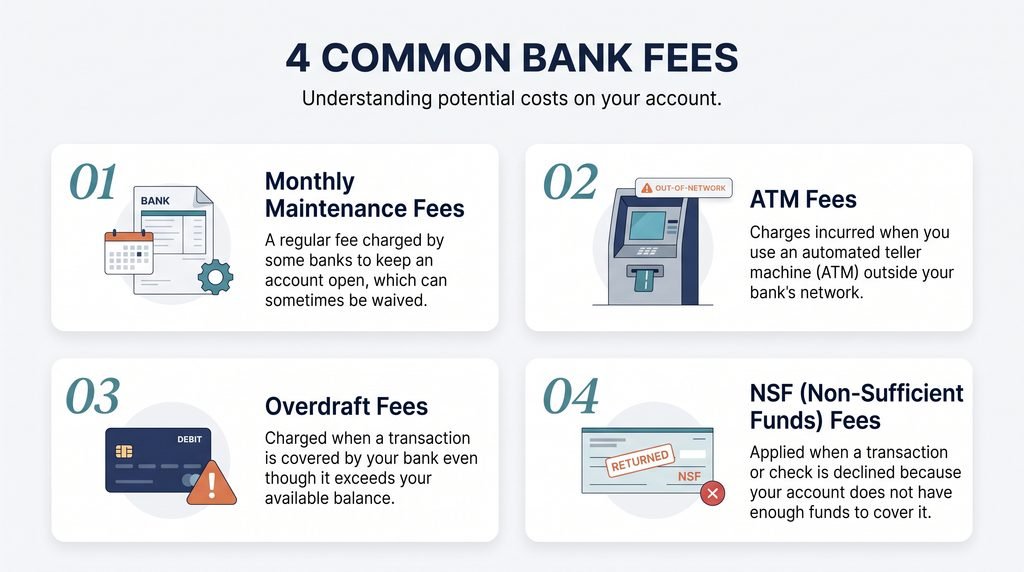
Banks and credit unions may charge fees for maintaining an account, processing certain transactions, or providing services. The exact charges and conditions depend on the account agreement and fee schedule.
Here are some common examples.
| Fee | What may trigger it | What to check |
|---|---|---|
| Monthly maintenance fee | Keeping an account open | Minimum balance, direct deposit, or waiver conditions |
| Out-of-network ATM fee | Using an ATM outside your bank’s network | Participating ATM locations and reimbursements |
| ATM operator fee | Using an ATM owned by another operator | On-screen fee notice before completing the transaction |
| Overdraft fee | A transaction is paid despite insufficient funds | Overdraft coverage settings and fee schedule |
| Non-sufficient funds (NSF) fee | A payment is returned or declined because funds are insufficient | Whether the bank charges an NSF fee and when |
| Minimum balance fee | Falling below a required balance | How the bank calculates the minimum |
| Wire transfer fee | Sending or receiving a wire | Domestic versus international transfer pricing |
| Paper statement fee | Receiving printed statements | Whether paperless statements are free |
| Stop-payment fee | Asking the bank to stop a payment | Fee amount and eligible payment types |
| Inactivity fee | An account remains unused for a specified period | Dormancy rules and how to keep the account active |
Not every bank charges every fee. Some accounts have no monthly maintenance fee but still charge for certain services, such as wire transfers or out-of-network ATM withdrawals.
Important: Do not assume an account is completely free just because it is advertised as free checking. Review the full fee schedule before opening it.
2. How to avoid monthly maintenance fees
A monthly maintenance fee is a recurring charge for keeping a deposit account open. It may apply to checking, savings, or money market accounts.
Some financial institutions waive this fee if you meet specific conditions.
Meet the account’s waiver requirements
Common waiver conditions include:
- Maintaining a specified minimum balance.
- Receiving qualifying direct deposits.
- Meeting an eligible account activity requirement.
- Qualifying for a student, senior, or other account option.
- Holding another eligible account or relationship with the institution.
The requirements vary. A bank may require a minimum daily balance, an average monthly balance, or a certain amount in qualifying direct deposits.
Read the exact terms rather than assuming that any deposit or balance will qualify.
Ask about a no-monthly-fee account
If you regularly pay a maintenance fee, ask your bank whether it offers another account without that charge.
You might find an account with fewer features but no monthly maintenance fee. That can be a reasonable trade-off if you do not need premium services.
Compare the other fees too. An account with no monthly fee may still be expensive if you frequently use out-of-network ATMs or need services that cost extra.
How to avoid bank fees
Consider switching institutions
If your current bank does not offer an account that fits your needs, compare other banks and credit unions.
Look at the complete cost of using each account, not just the advertised monthly fee. Check minimum opening deposits, balance requirements, ATM access, overdraft policies, and transfer charges.
The Consumer Financial Protection Bureau explains that banks and credit unions can charge monthly maintenance fees, but they must disclose the applicable fees and conditions. See the CFPB’s explanation of monthly maintenance fees.
3. How to avoid ATM fees
ATM withdrawals can sometimes involve two separate charges:
- A fee from your own bank for using an out-of-network ATM.
- A fee from the ATM operator for providing access to the machine.
The amount and availability of these fees depend on the institutions and ATM network involved.
Use your bank’s ATM network
Check your bank’s website or mobile app for an ATM locator. Use participating machines when possible.
If you travel regularly, look for an account that provides access to a larger ATM network or reimburses certain out-of-network fees.
Check for ATM fee reimbursements
Some financial institutions reimburse qualifying ATM fees, either up to a limit or under specific account conditions.
Before relying on reimbursement, check:
- Whether the reimbursement applies to domestic ATMs, international ATMs, or both.
- Whether there is a monthly reimbursement limit.
- Whether you must meet a balance or activity requirement.
- Whether the ATM operator’s fee is included.
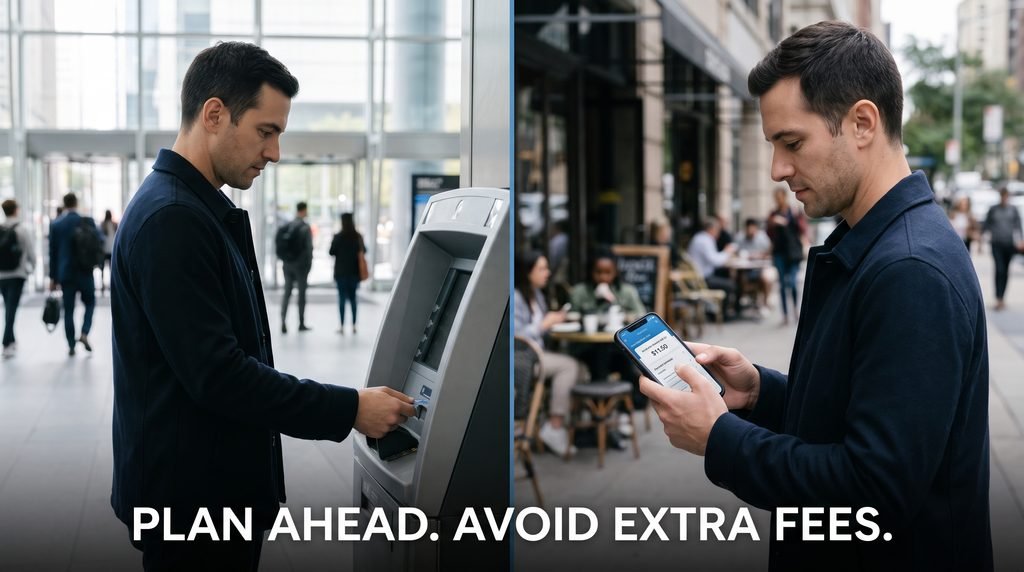
Plan cash withdrawals
If you often pay fees for small withdrawals, planning ahead may reduce how often you use an out-of-network ATM.
For example, you might withdraw the cash you expect to need for several days rather than making several separate withdrawals. Only take out an amount you can safely manage.
Read the ATM screen before confirming
An ATM may display its own fee before you complete a transaction. Review the amount and cancel if the charge is not worth it.
Remember that cancelling a transaction may not prevent a fee from your own bank in every situation. Check your account’s terms.
4. How to avoid overdraft fees
An overdraft happens when a bank pays a transaction even though your account does not have enough money to cover it. The bank may charge an overdraft fee in addition to the amount you owe.
Overdraft policies differ among institutions, and some accounts do not charge overdraft fees at all.
Understand debit-card overdraft opt-in
For ATM withdrawals and one-time debit-card transactions, federal rules generally require a consumer to opt in before a bank can charge an overdraft fee for paying those transactions.
If you do not opt in, the bank generally cannot charge you an overdraft fee for paying those covered ATM or one-time debit-card transactions. Your card transaction may instead be declined.
This protection does not mean every type of overdraft is fee-free. Checks and recurring electronic payments can be treated differently. You may still face overdraft or other fees depending on the bank’s policies and the transaction.
You can ask your bank whether you are enrolled in debit-card overdraft coverage and how to change your choice.
Consider linking a savings account
Some banks allow you to link a savings account to checking. If your checking balance is insufficient, the bank may transfer money from savings to cover the shortfall.
This service can have a transfer fee, so compare it with the bank’s overdraft fee before choosing it.
Also consider whether transferring money from savings could interfere with bills or savings goals.

Turn on low-balance alerts
Many banks let customers receive text messages, emails, or app notifications when an account balance falls below a selected amount.
A low-balance alert can give you time to transfer money or adjust spending before a scheduled payment arrives.
Set the alert above the minimum amount you need for upcoming bills. Remember that pending transactions and payment timing can affect your available balance.
Track scheduled payments
Keep a list of recurring payments such as rent, utilities, insurance, subscriptions, and loan payments.
Record their expected dates and amounts. This can help you avoid spending money that is already needed for an upcoming withdrawal.
The CFPB provides additional guidance in its Know Your Overdraft Options resource.
5. Understand NSF fees and returned payments
An NSF fee, or non-sufficient funds fee, may apply when a bank returns a check or declines a payment because the account does not have enough money.
An overdraft fee and an NSF fee are not necessarily the same thing:
- Overdraft: The bank pays a transaction even though the account lacks enough funds.
- NSF: The bank returns or declines a transaction because the account lacks enough funds.
Your bank’s policies determine which fees may apply. A returned payment may also create consequences outside your bank account, such as a late payment charge from the company expecting the money.
To reduce the risk:
- Check your available balance before making large payments.
- Keep track of checks that have not cleared.
- Review scheduled automatic payments.
- Use balance alerts.
- Ask your bank how it handles returned checks and electronic payments.
Declining debit-card overdraft coverage does not automatically prevent NSF fees or other charges associated with checks and recurring electronic payments.
6. Read the fee schedule before opening an account
A bank’s fee schedule is one of the most useful documents to review before choosing an account.
It explains the fees the institution may charge and the conditions that trigger them.
Look for these details:
Monthly maintenance: Is there a recurring charge? What conditions waive it?
Minimum balance: Is the requirement based on a daily balance, average balance, or another calculation?
ATM withdrawals: Are in-network withdrawals free? Are out-of-network fees reimbursed?
Overdraft and NSF: What happens when a payment exceeds your available balance? Can you decline debit-card overdraft coverage?
Transfers: Are there charges for wire transfers, expedited transfers, or other services you might use?
Statements: Are paper statements free, or is there a charge?
Account closure: Is there an early account closure fee or another condition to know about?
The FDIC recommends reviewing a bank’s deposit-account disclosures and fee schedule when comparing accounts. Its guide to Overdraft and Account Fees explains several common charges and ways consumers may reduce them.
7. Is a free checking account really free?
The term “free checking” has a specific meaning under the CFPB’s guidance.
An account described as “free” or “no cost” cannot charge certain fees, including monthly service fees, fees for exceeding a specified number of transactions, or fees for failing to maintain a minimum balance.
However, a free checking account may still charge other fees. Examples can include out-of-network ATM fees, overdraft fees, bounced-check fees, stop-payment fees, and check-printing fees.
That is why it is important to review the account’s full terms rather than relying on its marketing description.
Read the CFPB’s explanation: Can my bank charge fees on a free checking account?.
8. Worked example: How small bank fees can add up
Imagine a hypothetical checking account with these charges:
- Monthly maintenance fee: $10
- Out-of-network ATM fee from your bank: $3
- ATM operator fee: $3
- One overdraft fee: $30
Suppose you pay the monthly maintenance fee for 12 months, use an out-of-network ATM twice, and incur one overdraft fee during the year.
| Charge | Calculation | Annual cost |
|---|---|---|
| Monthly maintenance | $10 × 12 | $120 |
| Bank ATM fees | $3 × 2 | $6 |
| ATM operator fees | $3 × 2 | $6 |
| One overdraft fee | $30 × 1 | $30 |
| Total | $162 |
In this example, the fees add up to $162 over one year.
These figures are illustrative, not a statement of typical or current bank pricing. Actual charges vary by institution and account.
The example shows why it is useful to look beyond one fee. A bank account with no monthly maintenance fee may still cost money if you frequently use out-of-network ATMs or incur other charges.
9. A practical checklist for reducing bank fees
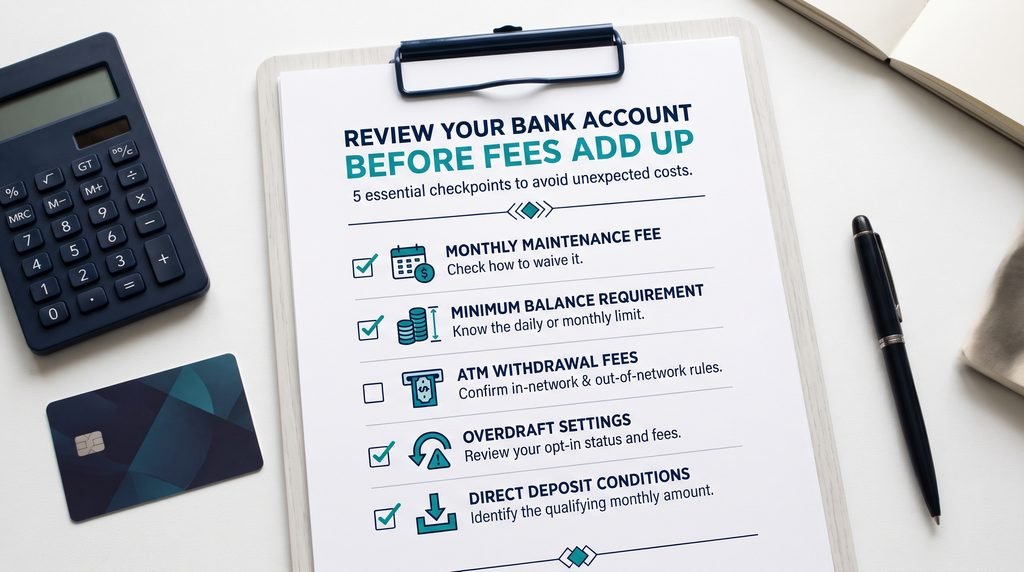
Use this checklist when reviewing your current checking or savings account.
- Download the latest account fee schedule.
- Identify any monthly maintenance fee.
- Check the conditions required to waive that fee.
- Confirm how the bank calculates minimum balances.
- Find nearby in-network ATMs.
- Check whether your bank reimburses ATM operator fees.
- Review your overdraft opt-in status.
- Ask whether linked-account transfers have a fee.
- Turn on low-balance alerts.
- Review recurring payments and their scheduled dates.
- Check for paper statement or inactivity fees.
- Compare your current account with lower-fee alternatives.
You do not need to change everything at once. Start with the fees you actually pay, then focus on the account features that would prevent those charges.
10. When should you consider changing bank accounts?
Consider comparing other accounts if:
- You regularly pay a monthly maintenance fee.
- You cannot reasonably meet the minimum balance requirement.
- You frequently pay out-of-network ATM fees.
- Your bank’s overdraft policy does not suit your needs.
- You need services that your current account charges extra for.
- Another account offers the features you use with fewer fees.
Before switching, check whether your existing account has pending transactions, automatic payments, direct deposits, or linked services.
A careful transition can help prevent missed payments or interruptions to your regular banking.
Frequently asked questions
Can a bank charge a monthly maintenance fee?
Yes. Banks and credit unions may charge monthly maintenance fees on deposit accounts. They must disclose the applicable fee and conditions. Some accounts waive the fee when customers meet requirements such as maintaining a qualifying balance or receiving eligible direct deposits.
How can I avoid ATM fees?
Use ATMs in your bank’s network, check whether your account reimburses out-of-network fees, and review the fee displayed by an ATM before completing a withdrawal.
Can I stop my bank from charging overdraft fees?
You can generally decline or cancel overdraft coverage for ATM withdrawals and one-time debit-card transactions. This prevents overdraft fees for paying those covered transactions when you have not opted in. It does not necessarily prevent fees involving checks or recurring electronic payments.
Is free checking completely free?
Not necessarily. A free checking account cannot charge certain account maintenance and minimum-balance fees, but it may still charge for services such as out-of-network ATM use, wire transfers, stop payments, or other transactions.
What is the difference between an overdraft fee and an NSF fee?
An overdraft fee may apply when the bank pays a transaction despite insufficient funds. An NSF fee may apply when the bank returns or declines a transaction because funds are insufficient. The exact policies depend on the financial institution.
Should I switch banks to avoid fees?
It may make sense if your current account regularly charges fees you cannot reasonably avoid. Compare the full fee schedules, account requirements, ATM access, and services before switching.
Where can I find my bank’s fees?
Look for the account’s fee schedule and deposit-account agreement. You can usually find these documents on the bank’s website, in its mobile app, or by requesting them from customer service.
Final thoughts
Avoiding bank fees starts with understanding how your account works. Review the fee schedule, learn the conditions for waiving monthly charges, use convenient in-network ATMs, and make an informed choice about overdraft coverage.
If your current account repeatedly charges fees for services you need, compare alternatives. The best account is not necessarily the one with the most features. It is the one that provides the services you actually use at a cost and under conditions you can manage.
Sources and methodology
This guide uses consumer guidance and regulatory information from the Consumer Financial Protection Bureau and Federal Deposit Insurance Corporation. Account fees, waiver requirements, and optional services vary by financial institution. Readers should verify current terms directly with their bank or credit union before making account decisions.
- CFPB: Monthly maintenance fees
- CFPB: Overdraft options
- CFPB: Fees on free checking accounts
- FDIC: Overdraft and Account Fees
- CFPB Regulation E: Requirements for overdraft services
This article is for general educational purposes and is not individualized financial, legal, or banking advice.