
How to Make a Monthly Budget That Actually Works

how to make a monthly budget
A monthly budget is useful when it reflects the way you actually earn, spend, and pay bills—not the way you think you should manage money.

The goal is not to restrict every purchase or make every month look identical. It is to give your income a clear purpose, make upcoming expenses easier to handle, and help you see whether your current spending supports your priorities.
You can build a workable budget with a few basic pieces of information: your take-home income, regular bills, everyday spending, less frequent expenses, and the amount you want to put toward savings or debt.
This guide walks through the process step by step, including a realistic $4,000 monthly example and a simple worksheet you can adapt to your household.
What Is a Monthly Budget?
A monthly budget is a plan for how you will use the money you expect to receive during a month. It compares your income with your planned expenses so you can decide where your money needs to go before it is spent.
A useful budget accounts for more than rent and groceries. It should also include debt payments, transportation, healthcare, subscriptions, savings, and expenses that do not arrive every month.
A budget is not a promise that every month will go exactly as planned. It is a starting point you can adjust when your bills, income, or priorities change.
The U.S. government’s Consumer.gov budget guide describes the basic process: record income, list expenses, subtract expenses from income, and use the result to plan the next month.
Step 1: Calculate Your Monthly Take-Home Income
Start with the money you can actually use—not your salary before taxes and payroll deductions.
Your take-home pay is the amount deposited into your bank account after deductions such as taxes, health insurance premiums, and retirement contributions.
Include income sources that are reasonably dependable, such as:
- Regular wages or salary after deductions
- A spouse or partner’s contribution to shared household expenses
- Reliable freelance or self-employment income after setting aside money for taxes
- Pension or retirement income
- Regular support payments or other recurring income
Do not count a possible bonus, an occasional gift, or an uncertain side gig as guaranteed income. If your income changes from month to month, use a cautious estimate based on your recent earnings and make a separate plan for months when you earn more.
Example: If your household receives two take-home paychecks of $2,000 each during a typical month, your monthly planning income is $4,000.
If you are paid weekly or every two weeks, do not assume that every calendar month contains the same number of paychecks. Build the budget around the actual dates money arrives. The guide to budgeting on a biweekly paycheck covers paycheck timing in more detail.
Step 2: Review What You Actually Spend
Before setting limits, find out where your money has been going.
Review at least the last one or two months of bank and credit card transactions. If your spending changes with the season, look back over three months or longer where possible.
Check:
- Checking and savings account statements
- Credit card statements
- Rent or mortgage records
- Utility and phone bills
- Insurance premiums
- Receipts and cash purchases
- Subscription and membership charges
Group purchases into categories that make sense for your household. For example, groceries, restaurants, transportation, housing, healthcare, and entertainment should be separate enough that you can tell where adjustments might be possible.
Do not leave out small purchases simply because they seem unimportant. A budget based on incomplete spending records can look balanced on paper but fail in real life.
The Consumer Financial Protection Bureau (CFPB) provides a spending tracker that can help organize purchases and identify patterns. Its guidance recommends tracking spending for at least two weeks—or longer—to get a clearer picture.
Step 3: List Your Essential Bills and Regular Expenses
Write down the expenses you need to plan for each month. Start with the payments that are necessary to keep your household running and meet your obligations.
Common categories include:
| Expense category | Examples |
|---|---|
| Housing | Rent or mortgage, property-related costs |
| Utilities | Electricity, gas, water |
| Food | Groceries and basic household supplies |
| Transportation | Fuel, public transit, car payment, insurance |
| Healthcare | Insurance premiums, prescriptions, regular care |
| Debt | Required credit card, student loan, and other loan payments |
| Communications | Internet and mobile phone service |
| Family needs | Childcare, school costs, dependent care |
Use actual bill amounts wherever possible. If a bill changes during the year, review previous statements and estimate a realistic monthly amount.
It can help to distinguish fixed and flexible expenses. A fixed expense is usually similar each month, such as rent. A flexible expense can change, such as groceries or fuel. Some expenses—like electricity—may be predictable in some months and much higher in others.
For a closer explanation, see Fixed vs. Variable Expenses: What Is the Difference?.

How to make a monthly budget
Step 4: Make Room for Expenses That Do Not Happen Every Month
One of the easiest ways to make a monthly budget unrealistic is to include only bills that arrive every 30 days.
Many household expenses occur quarterly, annually, seasonally, or only occasionally. Examples include:
- Car registration and maintenance
- Annual insurance premiums
- School supplies and fees
- Holiday and birthday spending
- Dental or medical costs not paid monthly
- Home repairs
- Membership renewals
- Travel to visit family
Look at what you spent on these items over the previous year. If you expect to spend $600 on car maintenance and registration over the next 12 months, set aside about $50 per month.
The calculation is:
Expected annual expense ÷ 12 = monthly amount to set aside
For example:
| Less-frequent expense | Expected yearly cost | Monthly amount |
|---|---|---|
| Car maintenance | $600 | $50 |
| Gifts and holidays | $480 | $40 |
| Annual memberships | $240 | $20 |
| School costs | $360 | $30 |
| Total | $1,680 | $140 |
These are illustrative figures. Replace them with estimates based on your own bills and plans.
Keep these monthly contributions in a separate savings category or account if that makes them easier to manage. When the bill arrives, the money has already been planned for.
For more detail, read How to Budget for Irregular Expenses.
Step 5: Decide What You Want Your Budget to Prioritize
Once you know your income and expenses, decide what matters most.
Most households need to balance several priorities:
- Paying essential household bills.
- Meeting required debt payments and other obligations.
- Covering food, transportation, healthcare, and family needs.
- Setting aside money for irregular expenses.
- Building savings or working toward a financial goal.
- Leaving room for personal spending and enjoyment.
The order and amounts will differ from household to household. Someone managing high medical costs may have a very different budget from someone with no dependents and low housing costs.
Avoid assuming that a popular percentage rule will automatically fit your situation. The 50/30/20 method can be a useful starting point for some people, but it is not a requirement. If you want to understand that approach, see 50/30/20 Budget Rule Explained.
Step 6: Give Every Dollar a Planned Job
Now assign your monthly income to the categories you created.
Here is an illustrative household budget based on $4,000 in monthly take-home income:
| Category | Planned amount |
|---|---|
| Housing | $1,300 |
| Utilities | $250 |
| Groceries and household basics | $450 |
| Transportation | $350 |
| Insurance and healthcare | $250 |
| Minimum debt payments | $200 |
| Savings | $400 |
| Personal spending and entertainment | $300 |
| Irregular-expense fund | $250 |
| Monthly buffer | $250 |
| Total planned | $4,000 |
| Money remaining | $0 |
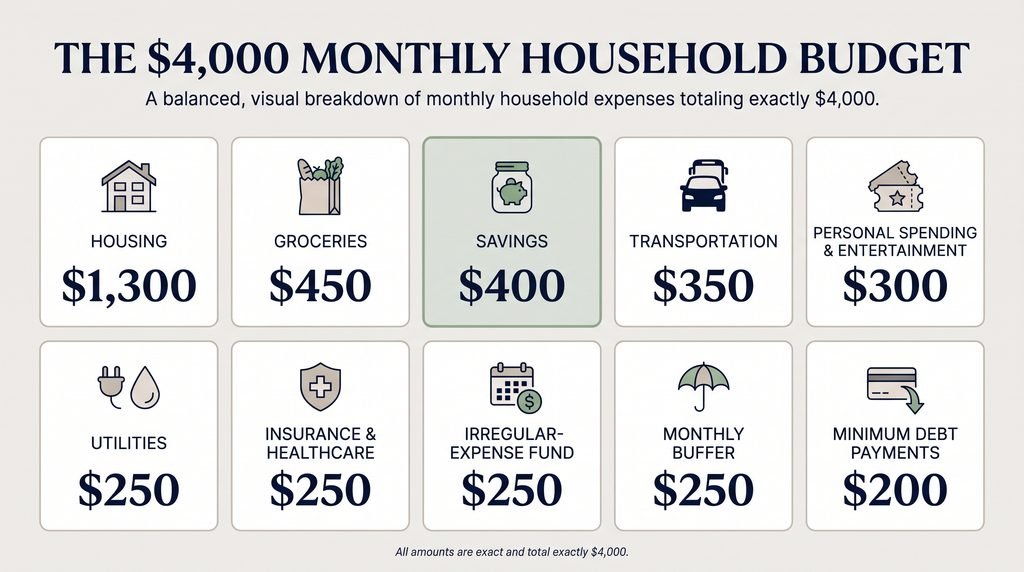
This example shows how the full amount can be assigned without leaving unexplained money. It is not a recommended allocation for every household. Housing costs, insurance, debt, family size, location, and income can make a realistic budget look very different.
Notice that savings and irregular expenses are included as planned categories. They are not simply whatever happens to be left at the end of the month.
The buffer is also intentional. It gives the household some room for small price changes or spending that was underestimated. If it is not needed, the remaining amount can be moved toward a priority such as savings or debt repayment.
Step 7: Check Whether the Budget Works on Your Paydays
A budget can balance for the month and still create problems if bills are due before your income arrives.
Write down:
- Each payday
- The amount expected from that paycheck
- Every bill’s due date
- Automatic withdrawals
- Planned transfers to savings
- Any weeks with unusually high expenses
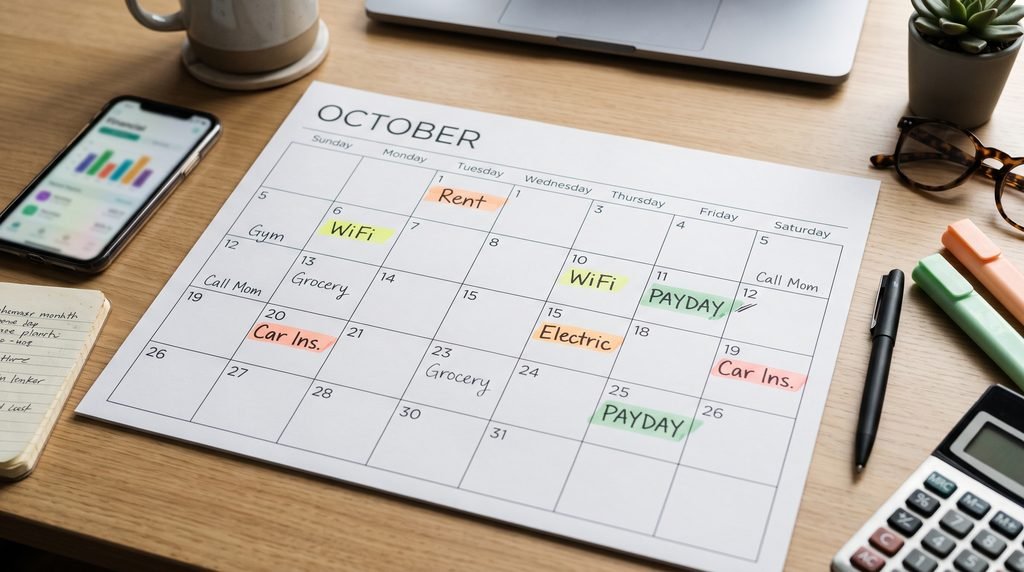
For example, a household might receive income on the 1st and 15th, while rent is due on the 1st and a car payment is due on the 10th. The monthly totals may work, but the household still needs enough money available at the beginning of the month.
A bill calendar can help you see these timing issues. The CFPB explains how to create one in its guide, Bill Calendar: Know What You Owe and When It’s Due.
If the timing does not work, consider whether a bill’s due date can be changed. Contact the provider before missing a payment, and check whether any date change would affect fees or the next billing cycle.
Step 8: Track Your Spending During the Month
A budget is a plan. Tracking tells you whether the plan matches reality.
Choose a method you can maintain:
- A spreadsheet
- A budgeting app
- A notebook
- A spending tracker
- Your bank’s transaction categories, checked against statements
You do not need to record every purchase in an elaborate system. The important thing is to update the amounts often enough to know how much remains in each category.
For example, if you planned $450 for groceries and have spent $280, you have $170 left for the rest of the month.
Check your balances weekly. A short review can help you notice a category running over budget while there is still time to adjust.
Step 9: Compare Your Planned Spending With Actual Spending
At the end of the month, compare what you planned with what you actually spent.
| Category | Planned | Actual | Difference |
|---|---|---|---|
| Groceries | $450 | $490 | $40 over |
| Transportation | $350 | $320 | $30 under |
| Personal spending | $300 | $270 | $30 under |
In this example, groceries were $40 over budget. Transportation and personal spending were each below their planned amounts by $30. Together, those two categories leave $60 unspent—enough to cover the grocery difference, with $20 remaining.
The point is not to treat every overage as a failure. Ask why it happened.
- Did prices increase?
- Did you underestimate how much the household uses?
- Was there a one-time purchase?
- Did an expense belong in a different category?
- Is the original amount no longer realistic?
If a category is consistently higher than planned, update the budget. A realistic plan is more useful than repeatedly trying to meet a number that does not reflect your circumstances.
Step 10: Adjust the Budget When Your Income or Expenses Change
Your budget should change when your life changes.
You may need to revise it after:
- A change in work hours or salary
- A new job or loss of income
- A rent increase
- A new loan or debt payment
- A change in childcare or healthcare costs
- A move to a different area
- A new household member
- A major repair or other unexpected expense
If income falls, start by updating the income figure. Then review essential costs, required payments, and flexible categories. Do not keep using an old budget that assumes money you no longer receive.
If your income varies, use a cautious baseline rather than building essential commitments around your best month. You can decide how to use extra income after it arrives. The separate guide How to Budget When Your Income Changes covers this situation in more depth.
What If Your Expenses Are Higher Than Your Income?
If your planned expenses exceed your take-home income, the budget has identified a shortfall. That is useful information: it shows that the current plan needs to change.
Start with a clear picture of the gap. Then:
- Check that your income and expenses are recorded accurately.
- Separate essential costs and required obligations from optional spending.
- Look for flexible expenses that can be reduced without creating a bigger problem.
- Review recurring services, memberships, and subscriptions.
- Contact lenders or service providers before a payment is missed to ask about available options.
- Consider whether additional income, public benefits, or local assistance may be available.
Some households have very little discretionary spending to reduce. If most of the budget goes toward housing, food, healthcare, childcare, transportation, and debt, cutting small purchases may not solve the problem. The next step may involve looking at larger costs, payment arrangements, assistance programs, or income options.
Do not ignore an essential bill or stop making a required payment without understanding the possible consequences. If you are struggling to cover basic needs, a nonprofit credit counselor or qualified local assistance organization may be able to help you review your options.

A Simple Monthly Budget Worksheet
Use this worksheet to create your own plan. Enter your actual take-home income and replace the example categories with expenses that apply to your household.
| Monthly income | Amount |
|---|---|
| Take-home pay | $_____ |
| Other reliable income | $_____ |
| Total monthly income | $_____ |
| Monthly expenses | Planned amount | Actual amount |
|---|---|---|
| Housing | $_____ | $_____ |
| Utilities | $_____ | $_____ |
| Groceries and household supplies | $_____ | $_____ |
| Transportation | $_____ | $_____ |
| Insurance and healthcare | $_____ | $_____ |
| Debt payments | $_____ | $_____ |
| Phone and internet | $_____ | $_____ |
| Childcare or family costs | $_____ | $_____ |
| Personal spending | $_____ | $_____ |
| Entertainment and subscriptions | $_____ | $_____ |
| Savings | $_____ | $_____ |
| Irregular-expense fund | $_____ | $_____ |
| Other expenses | $_____ | $_____ |
| Total expenses | $_____ | $_____ |
Monthly balance = Total monthly income − Total monthly expenses
A positive balance means your planned income is higher than your planned expenses. A negative balance means you need to revise the plan. A zero balance means every dollar has been assigned a purpose; it does not mean your bank account should be empty, because your plan may include savings and a cash buffer.
You can also use the official Consumer.gov Budget Worksheet as a printable starting point.
Common Monthly Budgeting Mistakes to Avoid
Forgetting annual and occasional bills
A budget that excludes car registration, repairs, school costs, and annual renewals may look affordable until those bills arrive. Estimate less-frequent expenses and set aside a monthly amount for them.
Using gross income instead of take-home pay
Your budget needs to reflect the money available after payroll deductions. Using gross salary can make your available spending money look higher than it really is.
Setting limits without checking past spending
A grocery budget should be based on household needs and actual prices—not a number chosen because it looks good. Review past transactions before setting category limits.
Making the budget too restrictive
If you remove every personal or flexible expense, the plan may be difficult to maintain. Include reasonable spending for the things that matter to you, as long as the full budget remains workable.
Treating savings as an afterthought
If saving is a priority, include a realistic amount in the plan. It is better to choose an amount you can sustain than to set an ambitious target that forces you to rely on credit for ordinary expenses.
Failing to review the plan
A budget is not something you create once and forget. Check it during the month and revise it when your actual costs or circumstances change.
Frequently Asked Questions
How do I make a monthly budget for the first time?
Start by calculating your monthly take-home income. Review recent bank and credit card statements, list your regular bills, estimate less-frequent expenses, and assign amounts to each category. Compare your planned expenses with your income, then track your spending and adjust the plan after the first month.
What is the easiest way to create a monthly budget?
A spreadsheet or simple written worksheet is enough to begin. Record income, list expenses by category, and subtract total expenses from total income. Choose a tracking method you will actually use rather than starting with a complicated system.
How much of my income should go toward savings?
There is no single savings percentage that works for every household. The amount depends on income, essential expenses, debt obligations, existing savings, and personal goals. Start with an amount that fits after essential bills and required payments, then review it as your circumstances change.
Should I include savings as a monthly expense?
Yes, if saving is one of your priorities. Including it in the budget gives it a planned place instead of relying entirely on whatever remains at the end of the month. Keep the amount realistic so that ordinary bills do not push you into borrowing.
What should I do if I cannot make my budget balance?
First, check your numbers and confirm that you are using take-home income. Then identify essential expenses, required payments, and flexible spending. Look for changes that are practical, and contact creditors or service providers before missing payments to ask about options. If essential expenses alone exceed income, you may need broader support rather than just smaller spending cuts.
How often should I review my monthly budget?
Check spending at least once a week and compare planned with actual amounts at the end of each month. Review it sooner if your income, bills, household size, or financial priorities change.
Is a monthly budget still useful if my income changes?
Yes. Use a cautious estimate for essential planning and pay close attention to when income arrives. When you earn more than expected, decide how to allocate the extra money after it is received. When income is lower, revise the plan promptly rather than relying on an outdated estimate.
Final Thoughts
A monthly budget works best when it is built around your real income, real bills, and real priorities. Start with the numbers you can verify, include expenses that do not arrive every month, and leave room for the unexpected.
You do not need a perfect budget on the first attempt. Track what happens, learn which estimates were too high or too low, and make adjustments. Over time, that process can give you a clearer view of your household finances and help you make more deliberate decisions with the money you have.