
How to split household bills based on income When You and Your Partner Earn Different Incomes

how to split household bills based on income
Sharing a home often means sharing expenses, but deciding who should pay what can become complicated when one partner earns more than the other.

A 50/50 split is simple. However, paying half of every household bill may put a much heavier strain on the partner with the smaller paycheck. An income-based split offers another option: each person contributes a percentage of shared expenses based on their share of the household income.
There is no single arrangement that works for every couple. The goal is to agree on a system that covers household costs, feels manageable to both partners, and leaves room for individual financial independence.
1. Start by listing your shared household expenses
Before choosing a splitting method, work out how much your household actually spends on shared costs.
Common shared expenses include:
- Rent or mortgage payments
- Electricity, gas, water, and other utilities
- Internet service
- Groceries and household supplies
- Shared transportation or household costs
- Childcare expenses, if applicable
- Household insurance and other agreed bills
Decide together which expenses belong in the shared budget and which remain personal.
For example, one partner’s personal subscriptions, clothing, hobbies, or individual debt payments may stay outside the shared-expense calculation. Other couples may agree to include certain additional costs.
The important thing is to define the arrangement before calculating each person’s contribution.
2. Compare three common ways to split household bills
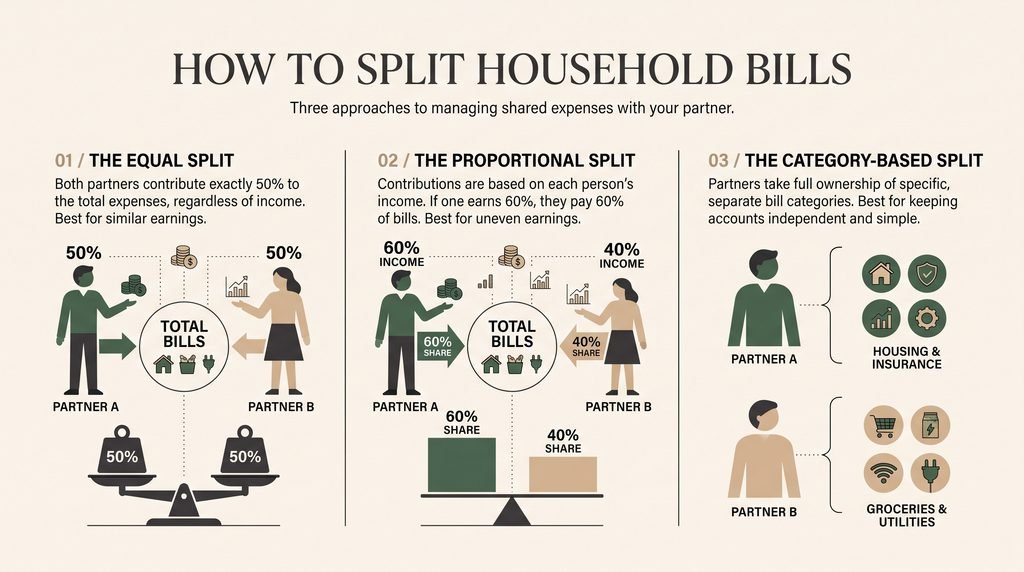
Method 1: Split everything 50/50
With an equal split, each partner pays half of every shared expense.
Suppose your monthly shared household expenses are $3,000.
- Partner A pays $1,500.
- Partner B pays $1,500.
This approach is straightforward and may work well when both partners have similar incomes and financial responsibilities.
However, equal dollar contributions do not necessarily represent equal financial effort.
If one person earns substantially less, paying the same amount may consume a much larger percentage of their income.
Method 2: Split bills according to income
An income-based split assigns each partner a percentage of shared expenses based on their share of the combined household income.
For example:
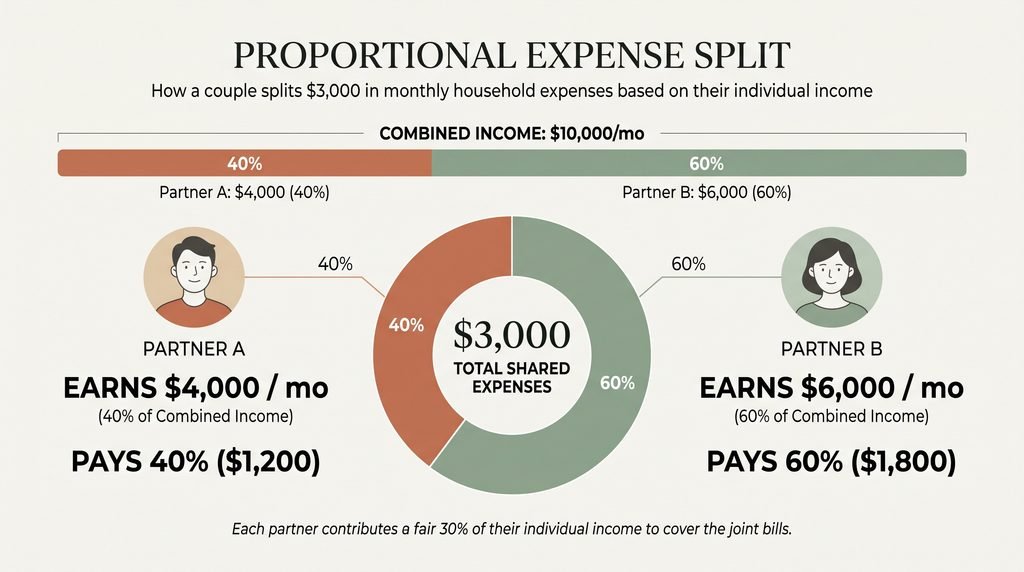
- Partner A takes home $4,000 per month.
- Partner B takes home $6,000 per month.
- Combined monthly take-home income is $10,000.
Partner A earns 40% of the combined income, while Partner B earns 60%.
If shared household expenses total $3,000, the contributions would be:
| Expense contribution | Partner A | Partner B |
|---|---|---|
| Share of household income | 40% | 60% |
| Shared monthly expenses | $3,000 | $3,000 |
| Monthly contribution | $1,200 | $1,800 |
Both partners contribute the same percentage of their combined take-home income: 30%.
This approach can make the financial responsibility more balanced when incomes differ significantly.
Method 3: Divide bills by category
Some couples prefer assigning entire expense categories to each person.
For example:
- Partner A pays the rent.
- Partner B pays groceries and utilities.
- Both contribute to other agreed household expenses.
This can make bill payments easier because each person knows which expenses they are responsible for.
However, the value of those categories may change. Grocery and utility costs can fluctuate, while rent may remain relatively stable.
Review the actual amounts regularly. If one person consistently pays more than the agreed share, adjust the arrangement or settle the difference.
3. How to calculate an income-based household bill split
You can calculate each partner’s contribution using two simple steps.
Step 1: Calculate each person’s share of combined income.
Partner’s income ÷ Combined household income × 100
Step 2: Apply that percentage to shared expenses.
Partner’s income percentage × Total shared expenses
For example, assume:
- Partner A earns $3,500 per month.
- Partner B earns $5,500 per month.
- Combined income is $9,000.
- Shared household expenses total $2,700.
Partner A’s share:
$3,500 ÷ $9,000 × 100 = 38.89%
Partner B’s share:
$5,500 ÷ $9,000 × 100 = 61.11%
Their contributions are approximately:
- Partner A: $2,700 × 38.89% = $1,050
- Partner B: $2,700 × 61.11% = $1,650
Together, they cover the full $2,700 household budget.
A useful tip: Consider using regular take-home pay for this calculation because it reflects the money available after payroll deductions. If income changes from month to month, agree on a reasonable average and review it periodically.
how to split household bills based on income
4. Decide whether a joint account makes sense
A joint account is one way to manage shared household expenses, but it is not required.
Couples generally have several options:
Separate accounts: Each partner keeps their own account and pays their agreed share of household bills.
Joint household account: Both partners contribute an agreed amount to an account used for shared expenses, while retaining separate accounts for personal spending.
Combined finances: Both partners pool their income and manage household spending together.
A separate joint household account can provide a middle ground. It creates a dedicated place for shared expenses without requiring both people to combine all their finances.
Before opening or using a joint account, discuss account access, spending permissions, fees, and what happens if the arrangement changes.
5. Agree on what happens when income changes
An expense-sharing arrangement should not remain fixed if your financial circumstances change.
For example, one partner might:
- Receive a salary increase.
- Change jobs.
- Experience reduced working hours.
- Become unemployed.
- Take parental or medical leave.
- Start earning irregular self-employment income.
When this happens, revisit the percentages and household budget.
If one partner temporarily stops earning, a strict income-based calculation may no longer be appropriate. You may decide to pool available income, adjust expenses, or use another arrangement that reflects the household’s circumstances.
The important part is to discuss changes openly rather than allowing one person to carry an unexpected burden without agreement.

6. Include unpaid household responsibilities in the conversation
Income is not the only contribution a person can make to a household.
One partner might earn less because they handle more childcare, household management, or other unpaid responsibilities.
A fair conversation should consider both financial contributions and the work that keeps the household running.
This does not mean every household must assign a dollar value to unpaid work. It means both partners should recognize their responsibilities and agree on an arrangement that respects each person’s contribution.
7. Review your arrangement once a month
Even a good bill-splitting system can become outdated when expenses and incomes change.
Set aside a short monthly check-in to review:
- Total household expenses.
- Each partner’s contribution.
- Any unexpected bills.
- Changes in income.
- Upcoming large household costs.
- Whether the current arrangement still feels manageable.
Keep a shared spreadsheet or expense record so both partners can see what has been paid.
A transparent record can reduce confusion and help you make adjustments before small disagreements become larger problems.
Frequently Asked Questions
Should couples always split household bills 50/50?
No. A 50/50 split is one option, particularly when incomes are similar. Couples with different earnings may prefer proportional contributions based on income or another mutually agreed arrangement.
Is splitting bills based on income fair?
It can be a useful approach when one partner earns more. Each person contributes according to their percentage of combined income, which can make the financial burden more balanced. However, the right arrangement also depends on household responsibilities, personal circumstances, and shared preferences.
Should we use gross income or take-home pay?
Take-home pay can be a practical starting point because it reflects the income available after payroll deductions. If either partner has variable income, discuss how to calculate a reasonable monthly average.
What if one partner earns no income?
A strict percentage-based calculation may not work when one partner has no earnings. Couples can instead plan their household finances together, taking unpaid responsibilities and available household income into account.
Do couples need a joint bank account to split bills?
No. Couples can keep separate accounts and pay their agreed portions directly. A joint account is simply another option for organizing shared expenses.

Final thoughts
Splitting household bills fairly is less about finding one perfect formula and more about agreeing on a system that works for both people.
A 50/50 split may be convenient for couples with similar incomes. An income-based arrangement can be more manageable when earnings differ, while dividing bills by category may simplify everyday payments.
Start by listing shared expenses, compare your available incomes, and choose an arrangement you can both maintain. Review it when circumstances change.
The best household budget is one that supports shared responsibilities without making either partner feel financially overlooked.
Sources and further reading
- FDIC — Saying “I Do” to Sharing Finances
- TD Bank — A Budget Built for Two: How to Manage Money as a Couple
- Consumer.gov — Making a Budget
This article provides general educational information, not individualized financial, legal, tax, investment, or credit advice.