
Subscriptions You May Be Paying for Without Realizing
Subscriptions You May Be Paying for Without Realizing is easier to understand when you treat subscriptions as part of a larger household cash-flow system rather than a stand-alone number. The practical question is not simply what an average person spends. It is what your own income, obligations, location, goals, and risk tolerance can support without creating unnecessary financial stress.
This guide explains the mechanics behind recurring costs, the main factors that change the result, and a step-by-step way to build a realistic estimate. The examples are educational, not personalized financial advice, and the numbers you use should come from your own bills, account terms, quotes, and local costs whenever possible.
For a stronger decision, focus on unused services. Those drivers usually explain more than a national average or a rule of thumb. A useful plan measures the current baseline, tests a target, and then reviews the result after a few weeks or months of real behavior.
Start with the right question
A low price is not automatically a good value. Value depends on how often an item is used, how long it lasts, whether it replaces another cost, and how well it fits the buyer’s real needs. This is why total cost and cost per use are often better measures than sticker price.
For subscriptions, the best starting question is usually: what decision are you trying to make? You may be setting a monthly target, comparing two options, preparing for a move, or trying to reduce spending. The answer changes the information you need. A comparison decision requires consistent categories and time periods, while a planning decision requires a margin for uncertainty.
Write the decision at the top of a page before collecting numbers. Then list the few variables that can actually change the outcome. For this topic, pay particular attention to unused services. Avoid collecting dozens of details that do not affect the choice. A short decision model is easier to update and less likely to create false precision.
Build a realistic baseline
Comparison shopping should use equivalent products and time periods. A monthly subscription should be compared with the monthly equivalent of an annual plan. Bulk groceries should be compared using unit price. Financing offers should be compared using total cost, not just monthly payment.
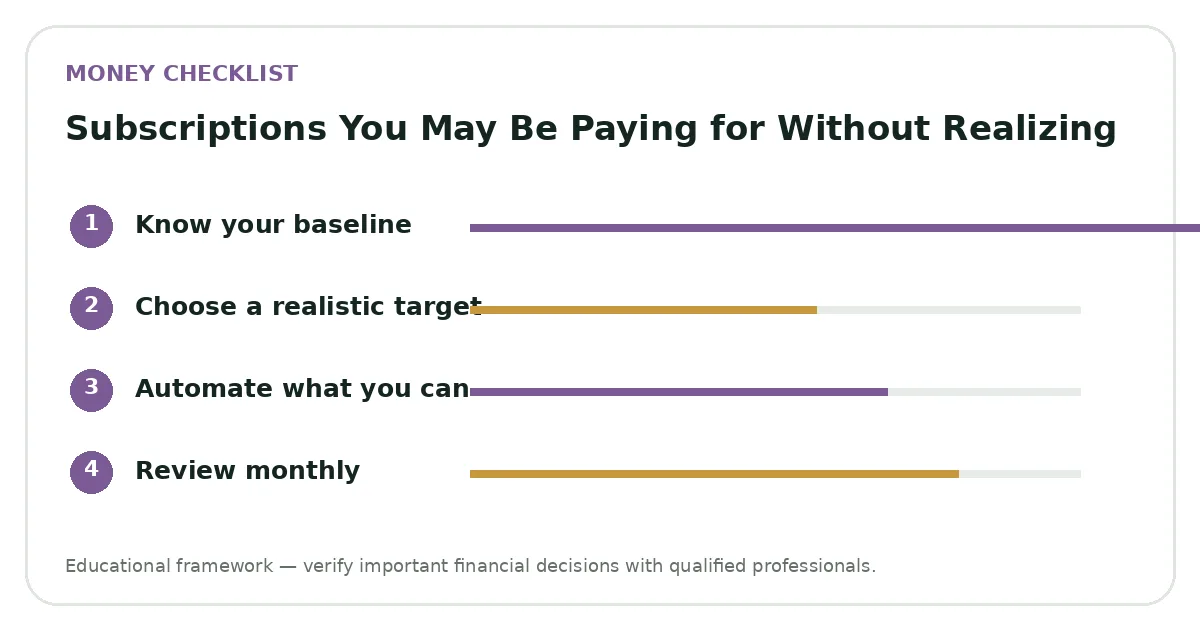
A baseline is your current reference point. Gather several months of statements, bills, receipts, or account data connected to subscriptions. If the expense is seasonal, use a longer period. If the expense is new, use multiple quotes and a conservative range rather than one promotional price.
Separate recurring costs from occasional costs. Recurring items determine the normal month, while annual renewals, repairs, medical costs, travel, gifts, and setup fees can create spikes. Converting predictable annual costs into monthly sinking-fund contributions makes the baseline more stable.
Do not force the baseline to match an ideal budget. If actual spending is higher than expected, record the real number first. Improvement begins with an accurate starting point, not with a target disguised as history.
Identify the biggest cost drivers
Friction can be useful. A 24-hour pause before nonessential purchases, a saved-items list, or a rule that requires checking one alternative can reduce impulsive spending without banning enjoyment. The goal is to make intentional purchases easier than automatic ones.
The largest drivers of subscriptions usually matter more than small optimizations. Rank the drivers by annual impact. If one category is ten times larger than another, spend more effort reviewing the larger category before cutting convenience purchases that barely change the total.
Price is only one driver. Frequency, quantity, financing, fees, contract length, taxes, and usage can all affect total cost. For example, a lower monthly price may be attached to a longer contract or a higher upfront cost. Put every option on the same time scale before deciding.
When prices vary, use a range. A low, expected, and high estimate is often more honest than one exact figure. The range helps you see whether the decision still works if a bill is higher than planned.
Use a simple calculation instead of a vague rule
Recurring costs deserve special attention because a small monthly charge compounds into a larger annual expense. Review subscriptions, insurance renewals, memberships, app charges, and service plans at least a few times per year.
For most decisions involving subscriptions, a simple spreadsheet or calculator is enough. List the inputs, calculate the monthly and annual totals, and compare the result with take-home income and other priorities. If the decision involves debt, include interest and fees. If it involves a purchase, include maintenance and replacement costs when they are material.
Rules of thumb can be useful as a first screen, but they should not replace the calculation. Households with the same income can have very different childcare costs, medical needs, commuting distances, debt obligations, or savings goals. A personalized baseline will usually be more useful than a national percentage target.
Use conservative assumptions for costs you cannot control. It is generally safer to underestimate future income than to assume every bonus, raise, or side-income payment will arrive exactly as planned.
Worked example
Imagine a household reviewing subscriptions. It begins with a monthly take-home income of $5,400 and lists its essential obligations before deciding on the target. The household then adds realistic estimates for unused services, plus a small monthly amount for irregular expenses. The important step is not the specific dollar figure; it is the sequence: income first, essentials second, goals third, and flexible spending last.
Next, the household tests the plan against a high-cost month. If one variable increases by 15% or an annual bill arrives, does the plan still leave enough cash for necessities and minimum obligations? This simple stress test is often more valuable than squeezing the budget to the last dollar.
Finally, the household sets a review date. After one full billing cycle, it compares the estimate with actual results and updates the plan. A budget becomes more accurate through repetition. The first version only needs to be useful enough to guide the next month.
How to reduce the cost without creating a bad trade-off
Do not optimize tiny purchases while ignoring large recurring decisions. Housing, transportation, insurance, debt interest, and major subscriptions can outweigh dozens of small lifestyle cuts. Start where the recurring dollars are largest.
Reducing subscriptions should start with waste, low-value extras, and pricing problems before cutting items that protect health, safety, work, or family stability. Compare providers, remove unused services, adjust frequency, and negotiate when the market allows it. Document any cancellation dates or contract terms before making changes.
Look for permanent savings rather than one-time discounts. A recurring $25 reduction can be more valuable than a single $100 coupon if it continues for years. At the same time, do not lock into a long contract solely for a small discount unless the service and flexibility still fit your needs.
Quality matters. The cheapest option can become more expensive if it fails early, causes repeated replacement, or requires extra travel and time. Use total cost and reliability when the decision is significant.
Common mistakes
Using averages as a personal spending target. Averages describe groups; they do not know your rent, household size, insurance, debt, location, or goals.
Ignoring annual and irregular expenses. These costs are predictable even when they do not occur every month. Convert them into monthly amounts when you build the plan.
Comparing offers with different assumptions. Match the time period, fees, quantities, coverage levels, and financing terms before deciding which option is cheaper.
Optimizing a small category while overlooking a much larger recurring cost. Review the annual impact of each change so you spend effort where it matters.
Treating the first estimate as permanent. Prices and household circumstances change. A good plan is reviewed and adjusted rather than defended.
A monthly review routine
Once a month, review the actual amount spent on subscriptions and compare it with the plan. Record the difference and identify why it happened. A higher bill may be caused by usage, a price increase, a one-time expense, or a timing issue. The reason matters because each cause has a different solution.
Then look ahead 30 to 90 days. Are renewals, travel, school costs, seasonal utilities, insurance premiums, or repairs likely? Move some money into sinking funds before those expenses arrive. Planning ahead reduces the need to use credit for costs that were foreseeable.
Keep the review short. A 15-minute monthly check that actually happens is better than a complicated system that is abandoned. The purpose is to notice trends early and keep money decisions aligned with current priorities.
Useful Hungama Money tools
Use these calculators to turn the framework into numbers:
Frequently asked questions
What is a reasonable starting point for subscriptions?
Start with your own recent spending or account data, then compare it with your take-home income and priorities. For a new expense, collect several realistic quotes and use a conservative range.
How often should I review subscriptions?
A monthly review works for most household decisions, with a deeper quarterly or annual review for major contracts, insurance, debt, and long-term goals.
Should I use national averages?
Use averages only as context. Local prices and personal circumstances can differ substantially, so decisions should be based on your own costs and reliable local information.
What if my income changes from month to month?
Build the plan around a conservative base income, keep flexible expenses adjustable, and use a cash buffer or sinking funds to absorb uneven months.
When should I get professional help?
Consider qualified professional guidance when a decision involves taxes, legal obligations, complex investments, insolvency, major debt distress, or other high-stakes circumstances beyond general education.
Sources and methodology
This article is educational and uses a household cash-flow framework rather than personalized financial advice. For current rules, consumer protections, and national data, consult official sources.
Related guides
- 20 Expenses You Can Reduce This Month
- Grocery Shopping Mistakes That Waste Money
- Costco vs Walmart: How to Compare Which Saves More
- Generic vs Name Brand: When Is It Worth Paying More?
How to make this plan easier to maintain
A strong subscriptions plan should reduce decision fatigue. Put recurring payments on a predictable schedule, keep important account information in one place, and automate transfers or reminders where automation is safe and appropriate. The less friction required to follow the plan, the more likely the household is to maintain it during busy or stressful months.
Use a small number of categories instead of building an accounting system. Broad categories make trends visible without requiring every purchase to be analyzed. Add detail only when a category is large enough or variable enough that the extra information helps you make a decision.
Keep a short note about assumptions. If a future price, raise, tax, insurance renewal, or rate is uncertain, record the assumption beside the estimate. When reality changes, you can update one input rather than rebuilding the entire plan. This also makes household money conversations calmer because everyone can see where a number came from.
Finally, define what success means. It may be reducing a recurring bill, reaching a savings target, staying within a grocery budget, paying down a balance, or simply knowing that upcoming costs are covered. A measurable goal makes it easier to judge whether the system is working.