Sequel raises the stakes with brutal games, biting satire, and a fearless heroine fighting back yet again
KARACHI:
Ready or Not 2: Here I Come, the newly released comedy-horror sequel hitting theatres this Eid-ul-Fitr, proves that lightning can strike twice.
Following the success of Ready or Not (2019), directors Matt Bettinelli-Olpin and Tyler Gillett return with a family that is just as grating, gruesome and darkly satirical, one again echoing the infamous “let them eat cake” sentiment.
Drawing on clear inspiration from genre standouts like Get Out, Gone Girl, and The Menu, the sequel expands its twisted universe while keeping its core premise intact: eat the rich and survive a game of power.

The story continues with Grace Le Domas, played brilliantly by Samara Weaving, whose ordeal began in the first film. Introduced as a young bride forced into a deadly wedding ritual at her husband’s lavish estate, Grace survived a horrifying game of hide-and-seek, lasting from midnight till dawn, while her in-laws hunted her with armed weapons. By the end, she turned the tables, wiping out the Le Domas family and burning their mansion to the ground.
One might assume that the film’s shocking climax would be enough, but the sequel wastes no time escalating the chaos. Having barely survived the last game, Grace now faces a greater threat: a sprawling network tied to Le Bail’s High Council. This time Grace has an even bigger army to fight.
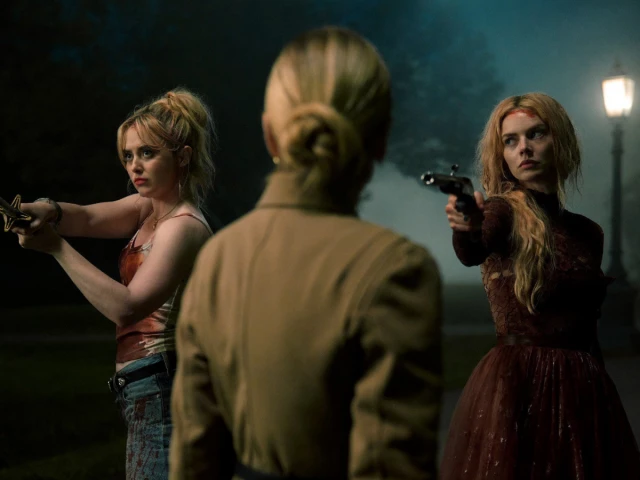
The film truly shines in its explanation of the character dynamics, particularly while introducing Grace’s estranged sister, Faith, played by Kathryn Newton. Their reunion, set against the bleak backdrop of a hospital following Grace’s rescue, adding emotional weightage to the carnage.
Faith’s casting feels spot on, complimenting Grace’s humour, sarcasm, and resilience. Together, they form a compelling duo, whose aim is to navigate a new game orchestrated by the High Council – a secret organisation of six ruling families, of which Le Domas clan was only one.

This time, the stakes are higher. Grace’s survival triggered a clause that forces her to another deadly round of hide-and-seek, with participants from all remaining families hunting her for a chane of power.
Much of the film takes place in the erie Danforth mansion, where the siblings – often handcuffed together – struggle not just against their hunters but also against their own conflicting issues. Their classes and decision making skills add tension to the hunt, but ultimately strengthens their bond. Who would have thought a brutal, real-life game of hide-and-seek could mend a fractured sisterhood?
Visually, the sequel intensifies everything. High-contrast lighting, stark whites, gothic tones, and vivid reds dominate the screen, creating palettes that enhance both horror and humour. The use of blood is excessively intentional, leaning into gore while maintaining a playful edge.
Grace’s iconic wedding dress – once again torn and progressively soaked in deeper shades of red, symbolises her transformation from being a terrified bride to an unhinged survivor, as noted by Radio Times.

The costume becomes a reminder that Grace is still trapped in the game.
What elevates the sequel further is its diverse and vibrant supporting cast. Actors like Wan Chen Xing (Olivia Cheng) stand out – not as villains but as morally ambiguous figures navigating the game’s twisted rules. Her attempt to exploit a legal loophole by marrying Grace to her son Wan Cheng Fu (Antony Hall) – a hilariously clueless phone-obsessed dufus – adds comedy and tension.
Their eventual demise, after defying game rules and accidentally killing Ignacio El Caído (Nestor Carbonell), delivers one of the film’s most absurd moments. Faith’s quip, “I’m not used to being exploded on”, drew genuine laughter from the audience.

The sequel also introduces a more diverse cast, such as brown leads Madhu Rajan (Varun Saranga) and Viraj Rajan (Nadeem Umar-Khitab). Viraj, dooming a mask mimicking Micheal Myers, meets a brutal end inside a washing machine, while his brother Madhu proves to be all talk, cowardly sacrificing his wife to the game.

Meanwhile, Francesca El Caído (Maia Jae), Grace’s husband’s ex, injects a dose of girly attitude to the chaos. Their confrontation results in a chaotic pepper spray-blinded fight underscored by Total Eclipse of the Heart playing in the background, leading to Grace smashing her with a piano and shooting her in the chest.

Under all this madness, Grace’s composure remains one of the film’s most compelling traits. Whether she’s casually drinking wine or using alcohol to treat her wounds, she stands in stark contrast to the wealthy elite who indulge in champagne at her suffering.
Kip Danforth (Dan Beirne), who absurdly spends the game in a bathrobe – even wrapping himself in plastic to avoid blood splatter – highlights the privilege and division.

The sibling duo Ursula (Sarah Michelle) and Titus (Shawn Hatosy) add another layer of intrigue. Ursula manipulates Titus, pushing him to madness, while Grace cleverly exploits a legal loophole by marrying him to save Faith – fully aware of the horrific consequences it would entail.

One of the film’s stand out sequences is the wedding scene, led by the lawyer (Elijah Wood), known for his iconic role in the Lord of the Rings franchise.
Grace, dressed in a black gothic gown paired with a black veil and striking crown, once again captivates. Whether in white or black, she demands our attention.

The performance of Faith and Titus further elevate the film, their banter and expressions mirroring Grace’s rage while adding depth and humour. The chemistry between the trio ensures that even during lengthy moments, the film still remains engaging.
The ending of the film was quite unexpected. In a clever twist, Grace uses her wedding to fulfill the game’s rules before killing Titus – now technically her family. As the lawyer opens the gateway to Hell, Grace, newly crowned with the High Seat of the Council, rejects the power entirely, throwing the ring down a well with a striking command: “fetch”.
In the end, Ready or Not 2: Here I Come delivers exactly what fans hoped for: more blood, more chaos, and more satire. With more intriguing diverse and compelling characters, some could say that the sequel achieved a brighter storyline than the original film.