
PUBLISHED
September 27, 2026

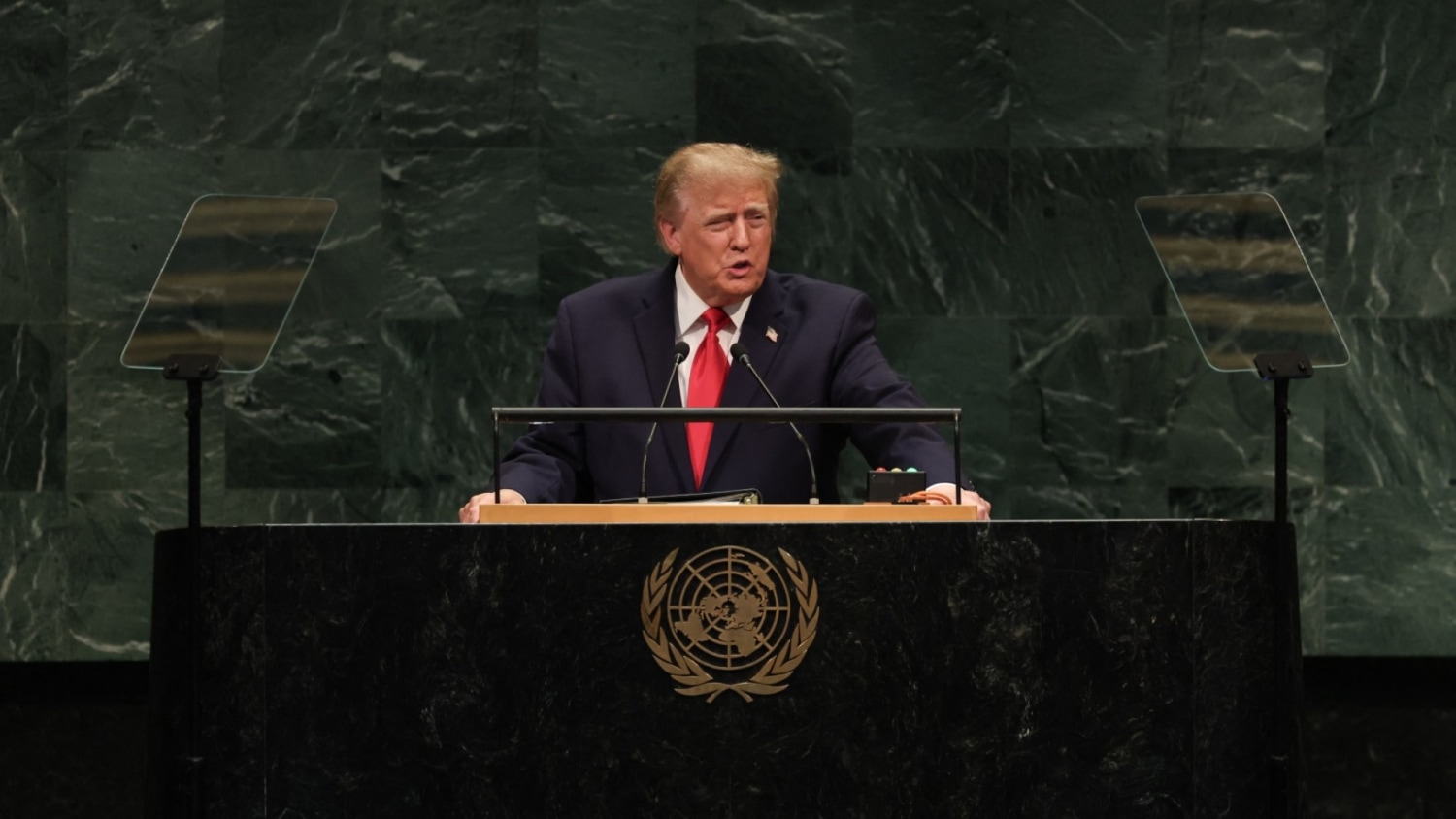
When Donald Trump stood before the United Nations General Assembly and spoke about annihilating another country, the room listened and for some observers, the more disturbing question was not what the American president said but what that silence revealed about the international system itself.
Standing before the UN General Assembly, Trump spoke about the war against Iran, celebrated American military power, and warned that Tehran faced “annihilation” if it did not make a deal with the US. This was not said at a usual political rally of supporters or a television interview, it was the UN, the institution created after the Second World War around a simple idea that countries should have a place to settle their disputes without turning to conflict.
There were walkouts, Iran’s delegation, as expected, left, as did Cuba’s, and governments have criticised Washington elsewhere, so the speech did not go unanswered in every corner of the building. But there was no collective protest from the General Assembly floor, no institutional interruption, and no immediate challenge to the language coming from the podium. For Jostein Hauge, a scholar of international political economy, that moment was more than just another provocative speech by Trump. “I say this with the utmost seriousness as a scholar of international political economy: the rules-based international order is dead,” Hauge wrote afterwards on X. It is an extraordinary claim, and also a useful place from which to examine what happened at the UN this week, because the question is not simply what Trump said but what the rest of the world can do when the country saying it is the United States.

Ashok Swain, professor of Peace and Conflict at Uppsala University, says the muted response was troubling precisely because of where it happened. “The United Nations is supposed to be the principal forum where threats to peace, attacks on human dignity and rejection of collective global responsibilities are challenged,” he says. Trump’s speech, in Swain’s reading, exposed the gap between that expectation and the reality of international politics. Trump used his address to defend the US war against Iran and present American military power as an instrument for dealing with international problems. He spoke proudly about the damage inflicted on Iran’s military infrastructure and described the United States as possessing unmatched military strength. He also attacked the International Criminal Court, criticised international institutions, and rejected international approaches to issues including climate change and artificial intelligence. On immigration, he repeated his familiar attacks on what he sees as an international system that constrains American sovereignty. But it was Iran that brought the question of war and international law most directly into the room, with Trump saying the choice facing Tehran was a deal or “annihilation.”
The legal question surrounding the US and Israeli attacks on Iran is contested. International law places significant restrictions on the use of force between states, with limited exceptions including self-defence and action authorised by the Security Council. Legal scholars have argued that the attacks violated the UN Charter, while the US and Israel have presented their own legal justifications. What is less ambiguous is the political message Trump was delivering, military power, rather than international institutions, was being presented as the mechanism through which Washington would secure its interests. And that message landed in an institution whose leaders had spent the opening of the General Assembly arguing for almost the opposite. The president of the General Assembly cautioned that international law and humanitarian law could not be applied selectively, and outgoing Secretary-General Antonio Guterres warned that geopolitical fault lines were widening and called for international law and cooperation to prevail over force. It was at that point that Trump took the podium, delivering a message that ran counter to everything the UN leadership had just said.
For Swain, the gap between what the UN says and what it can enforce goes to the heart of the problem. “When governments remain restrained in confronting a powerful state while speaking much more forcefully against weaker ones, silence itself can reinforce a hierarchy of power,” the Sweden-based academic notes. The hierarchy has always been there, even if the UN Charter speaks in the language of sovereign equality, because countries do not enter the international system with equal political, military or economic power. The United States is a permanent member of the Security Council and has a veto, it has one of the world’s largest economies, an enormous military, and a network of alliances that gives Washington influence far beyond what the formal structure of the General Assembly suggests. The General Assembly, by contrast, gives countries a voice without giving them equal power to enforce what they say. That itself has long frustrated countries in the Global South.
Swain says the issue is not simply that Washington gets away with everything, the deeper problem is that the consequences of violating international norms are themselves shaped by power. “A small or economically vulnerable country in the Global South that threatened another state can face diplomatic isolation, sanctions and potentially international intervention,” he says. The US has far greater capacity to resist those pressures because of its military strength, economic influence, alliances and veto power. “This asymmetry has long contributed to criticism from the Global South that international rules are enforced selectively,” he says. That selective application does something more damaging than create resentment: it weakens the legitimacy of the rules themselves.
The post-1945 international order was never the egalitarian system its rhetoric sometimes suggested. The US was one of its principal architects and, at the same time, one of the states with the greatest ability to shape the system in its own interests. But the system did establish something that created institutions in which smaller states could challenge powerful ones, build coalitions, negotiate, and make their grievances part of an international record. If those institutions cannot constrain the most powerful states, their value becomes harder to defend. That does not mean the UN becomes irrelevant, and Swain is careful about this. “The United Nations still has considerable value,” he adds. “But episodes like this expose the gap between its principles and its capacity to enforce them.” The organisation remains indispensable for diplomacy, humanitarian action, norm-building, and giving smaller countries a political platform. The problem is that the General Assembly does not possess the coercive authority to enforce most of its resolutions, and the Security Council, where enforcement power is greater, is dominated by five permanent members with vetoes, including the US. This has created a contradiction at the centre of the international system: countries are formally equal, but their ability to act on the rules is not.
Swain argues that the UN’s problem is therefore not simply that it has failed to stop Trump, the larger problem is the perception that the international system applies rules differently depending on who is involved. That perception is particularly dangerous in the Global South, where memories of colonialism and intervention already shape attitudes towards international institutions. A country that believes international law will protect it has an incentive to use diplomacy, while a country that believes international law will be ignored when a stronger state wants something else has a different set of incentives. It may seek stronger military alliances, build up its own weapons, or pursue nuclear deterrence. That is where the consequences of Trump’s rhetoric begin to extend beyond Iran. “The greatest danger is the gradual normalisation of the idea that military threats and force are legitimate tools of ordinary foreign policy,” Swain cautions.
 He shares an important observation here: offensive rhetoric, Islamophobic statements or climate denial are not, by themselves, automatically violations of international law, whereas the use or threat of force raises a different legal question. But when a US president repeatedly presents overwhelming military power as an acceptable way of dealing with sovereign states, the message does not stop at Washington. Other governments hear it too. If the United States can claim that its military power gives it the right to determine the terms of international disputes, why should other powerful countries accept restraints that Washington itself appears willing to treat selectively? “Russia, China, India or regional powers are all asking why they should accept restraints that Washington itself treats selectively,” Swain says. The result could be a more openly transactional international system in which military strength becomes more important, alliances become more important, arms control becomes harder, disarmament becomes harder, and smaller states become more vulnerable to the calculations of larger ones. The danger is not that every country suddenly decides to ignore international law, it is that the incentive to follow it begins to weaken. And once that happens, the system can deteriorate without ever formally collapsing.
That is why Swain is reluctant to reduce the problem to Trump himself. “The post-1945 system was never as rules-based or equal as its supporters sometimes claimed,” he says. But there was at least a widely accepted principle that military force should be constrained and that international institutions mattered, and that principle is now under pressure. At the opening of the General Assembly, the UN leadership repeatedly warned about a world in which power was replacing law. Trump’s speech showed what that replacement might sound like. There was no need for him to announce that the international system was being dismantled, he simply spoke as though its limits did not apply to him. That is more consequential than one speech, because international orders do not survive only because treaties exist on paper, they survive because governments believe that following the rules is preferable to breaking them, and because powerful states believe there will be consequences if they do. When either belief begins to disappear, the architecture remains standing but its authority starts to drain away.
This is where Hauge’s declaration that the rules-based order is dead becomes difficult to dismiss entirely, even if the word “dead” is too definitive. The order has not disappeared, of course, the UN remains, international law remains, states still invoke it daily, courts still hear cases, governments still negotiate treaties, and UN agencies still provide services on which millions depend. But an international system can survive institutionally while losing political credibility, and that may be the more important story coming out of this year’s General Assembly. Swain puts it more bluntly in terms of consequences. “The most damaging legacy of such rhetoric may therefore be not any single statement, but the precedent it helps establish that international law constrains the weak more effectively than the powerful.” Once that perception becomes deeply embedded, he warns, rebuilding trust in the international system will be extraordinarily difficult.